














What is phase 4 of a protein diet, and how do you keep the weight off for good?
Phase 4 is the maintenance phase of a structured protein diet. You've reached your target weight and are gradually broadening your diet into a pattern you can live with for years to come. In practice, that means keeping protein at a minimum of 1.2 grams per kilogram of body weight per day, raising your calories step by step to your maintenance level, and building movement properly into your week.
This is where most people come unstuck. Not during the weight-loss weeks, but afterwards. A study published in The New England Journal of Medicine (2010) found that participants who raised their protein intake from 13% to 25% of total energy after weight loss regained significantly less weight than the control group. The case for protein as your anchor in the maintenance phase is solid.
But protein alone won't cut it. What you actually need in phase 4 is a system. Not a diet any more, but a way of eating you can stick to on a tired Monday evening, on holiday, and on your birthday.
What happens biologically after weight loss
Your body has lost weight. What most people don't realise is that it then fights back. This is known as metabolic adaptation. Your resting metabolism drops by more than your weight loss alone would explain. Hormonal shifts, such as falling leptin and rising ghrelin, mean you feel hungry on an energy intake that would be entirely normal for someone at the same weight who'd never dieted.
To put it plainly: say you weighed 90 kg and have dropped to 75 kg. Someone who has always weighed 75 kg burns more calories at rest than you do right now. The gap can run to 200-300 kcal a day. That doesn't sound like much, but over a year it adds up to more than 10 kg of surplus if you don't adjust.
This isn't cause for pessimism. It's information. Once you know this mechanism exists, you can work with it deliberately. Two levers work best here: sufficient protein (which protects muscle mass and raises the thermic effect of food) and strength training (which rebuilds and maintains lean mass, boosting your resting metabolism).
The protein target for the maintenance phase: what does your body genuinely need?
The Dutch Nutrition Centre (Voedingscentrum) recommends 0.83 grams of protein per kilogram of body weight for healthy adults. That's a bare minimum to avoid deficiency, not a target for maintaining weight after a period of weight loss.
The British Dietetic Association (BDA), along with several metabolic studies, sets a target of 1.2 to 1.6 grams per kilogram for active adults in the maintenance phase. For someone weighing 70 kg, that works out at 84 to 112 grams of protein a day. Spread this across three to four meals of 25 to 35 grams each. That's the range at which muscle protein synthesis is stimulated most effectively per meal.
| Body weight | Minimum (1.2 g/kg) | Optimal (1.5 g/kg) | Protein meals per day |
|---|---|---|---|
| 60 kg | 72 g | 90 g | 3 x 25-30 g |
| 70 kg | 84 g | 105 g | 3-4 x 25-35 g |
| 80 kg | 96 g | 120 g | 4 x 30 g |
| 90 kg | 108 g | 135 g | 4 x 30-35 g |
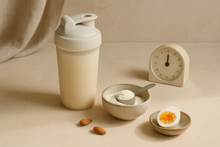
In real terms: breakfast with 30 grams of protein (think cottage cheese, eggs, or a Bioteïne protein shake), a protein-rich lunch, a snack of 15-20 grams in the afternoon, and a dinner built around fish, meat, pulses or tofu. Hit your target every day this way without it ever feeling like a chore.
Calories in phase 4: how much is enough without overdoing it
During the active weight-loss phases, you were in a deficit. Phase 4 calls for a fundamentally different mindset: you're moving to maintenance, not further reduction. That means recalculating your calorie needs based on your new weight and activity level.
A woman of 70 kg with a lightly active lifestyle needs roughly 1,900 to 2,100 kcal a day to maintain her weight. A man of 80 kg with a similar activity level sits at 2,300 to 2,600 kcal. These are starting points, not gospel: check your weight every two weeks at a fixed time (same day, same time) and adjust from there.
Take the transition slowly. Many people ramp up their calorie intake too quickly after the weight-loss period, often driven by a sense of having "earned it". That feeling is understandable, but it's also a trap. Increase in steps of 100-150 kcal a week. Give your body two weeks to respond before adding any more.
Widening your food groups: the right order
- Weeks 1-2: add complex carbohydrates to breakfast and lunch (porridge oats, rye bread, brown rice). Keep the evening meal protein-focused.
- Weeks 3-4: bring in healthy fats properly (nuts, avocado, olive oil with your hot meal).
- Week 5 onwards: increase your vegetable portions freely. Only then consider adjusting carbohydrate portions further, provided your weight stays stable.
If you've followed the 4-phase system, this principle will be familiar: you widen your diet in a controlled way, not all at once.
Movement as a foundation, not a punishment
Movement in phase 4 serves a different purpose than it did in phase 1 or 2. You're not using it primarily to burn calories. You're using it to raise your resting metabolism, preserve muscle mass, and keep insulin sensitivity in good shape.
Strength training, two to three times a week, is the single most effective intervention for long-term weight maintenance. Not cardio. Cardio burns calories in the moment; strength training raises your baseline metabolism because muscle tissue burns more energy at rest than fat tissue does. Every extra kilo of muscle mass burns roughly 13-15 kcal a day more at rest.
That sounds modest. But 3 kg of extra muscle mass is 45 kcal a day, or 16,000 kcal a year. That's over 2 kg of fat a year without any extra effort.
A realistic weekly schedule for phase 4
| Day | Activity | Duration | Goal |
|---|---|---|---|
| Monday | Strength training (upper body) | 40-50 min | Muscle preservation |
| Tuesday | Walking or cycling | 30-45 min | Boost NEAT |
| Wednesday | Rest or light activity | - | Recovery |
| Thursday | Strength training (lower body) | 40-50 min | Muscle preservation |
| Friday | Walking or swimming | 30 min | Boost NEAT |
| Saturday | Free or social sport | - | Mental reset |
| Sunday | Rest | - | Recovery |
NEAT stands for Non-Exercise Activity Thermogenesis: the energy you burn outside of formal exercise. Taking the stairs, standing rather than sitting, cycling instead of driving. In active people, NEAT can be 300-500 kcal a day higher than in inactive people following the same formal training schedule. It's well worth paying attention to.
The behaviour patterns behind most relapses
Weight loss rarely fails through lack of knowledge. It fails because of behaviour patterns. Three patterns dominate in clinical practice.
1. The "not right now" pattern
Holiday starts, structure falls away, and you tell yourself: "not right now". Two weeks later you're 2.5 kg heavier. Not dramatic in itself, but the barrier to starting again has suddenly grown. This "not right now" pattern is behind most of the weight fluctuations seen in people who've already hit their goal.
The fix: turn "not right now" into a defined window with a built-in restart rule. "I'll eat flexibly on holiday, but on the Monday after I'm back, I'll pick my morning routine straight back up." That's not a diet any more. That's a way of life.
2. Scale blindness
People stop weighing themselves the moment they hit their goal. Understandable, but the scale isn't a punishment, it's a signal. Weighing yourself weekly, at a fixed time, gives you an early warning system. Notice you're 2 kg up and you can simply tighten things for a fortnight. Notice it only after 8 kg, and the barrier is higher and the fix more drastic.
3. Diluting your protein intake
Calories go up in phase 4. Rightly so. But the extra calories often come from carbohydrates and fats, which quietly lowers the protein percentage of your overall diet. That's exactly the wrong moment for it to happen. Keep your protein intake fixed in grams, even as your total calorie intake rises. A protein bar as a snack or a complete protein meal can help you hold that baseline without tracking every gram.
Practical tools for long-term behaviour
Structure is more liberating than freedom. That sounds like a contradiction, but it isn't. People with clear habits around food snack less impulsively, eat less out of emotion, and relapse less after stressful periods.
The anchor breakfast
Pick one breakfast you can always make, always enjoy, and that delivers 25-35 grams of protein. Eat it the same way five days a week. That way, 35% of your daily protein target is sorted without a second thought, leaving you free to be flexible for the rest of the day.
The two-out-of-three rule
At every meal, make sure two of the three pillars are covered. The three pillars are: enough protein, vegetables, and minimal refined sugar. Missing one pillar isn't a problem. Missing all three at every meal is when it starts to add up.
The weekly check-in
Every Sunday: weigh yourself, rate the week on structure from 1 to 5, and plan three meals for the week ahead where you consciously choose what you'll eat. These don't need to be perfect meals. It's about intention, not perfection.
Not sure whether you're still in the right phase, or ready to move towards phase 4? Take the phase test and find out exactly where you stand.
What's proven to work for weight maintenance
The National Weight Control Registry in the US has tracked people who've lost at least 13 kg and kept it off for at least a year, for over 25 years now. The findings are remarkably consistent. People who maintain their weight long-term do four things as a matter of course.
- They eat breakfast every day, including a protein component.
- They weigh themselves at least once a week.
- They average 60-90 minutes of moderate-intensity movement a day (walking counts).
- They limit television time and other sedentary activities.
None of these factors are revolutionary. None require a perfect diet. They're consistent, low-effort and repeatable. That's precisely what phase 4 asks of you.
Read more about the scientific basis for protein intake in weight maintenance in Bioteïne's comprehensive high-protein diet guide, or check the recommendations from the Voedingscentrum for reference protein intakes by age group.
For a deeper dive into the science behind protein distribution across the day, the BDA Protein Fact Sheet references several systematic reviews on optimal protein spacing.
When you slip up: how to get back on track without the drama
A slip isn't a failure. It's a sign that a habit isn't quite automatic yet. On average, it takes 66 days for a new behaviour to become genuinely automatic (Lally et al., University College London, 2010). That means in phase 4, you'll still need to give your new habits conscious attention for at least two more months before they become routine.
If you notice your weight creeping up, follow this plan.
- Week 1: go back to the basic structure of three protein-rich meals a day, without slashing calories drastically.
- Week 2: add back one strength session if it had dropped off your schedule.
- Week 3: work out which specific habit slipped and restore that one. Don't try to fix everything at once.
Feel like you want to start completely from scratch? A starter pack can help you reclaim the structure of the first few weeks without having to figure it all out again.
A strict crash diet after a slip doesn't work. It only deepens metabolic adaptation and makes the next recovery harder. A calm, structured return works far better than a fast, harsh one.
Frequently asked questions
How long does phase 4 of a protein diet last?
Phase 4 has no end date. It's the permanent maintenance phase. You apply the principles for life: enough protein, regular movement, and weekly weight monitoring. The intensity of attention required tends to ease off as habits become more automatic, usually after 3 to 6 months.
How much protein do I need in the maintenance phase?
At least 1.2 grams of protein per kilogram of body weight per day. For optimal muscle preservation and satiety, 1.4 to 1.6 grams per kilogram is more realistic. At 75 kg, that's 105 to 120 grams of protein a day, spread across three to four meals of 25 to 35 grams each.
Can I eat carbohydrates again in phase 4?
Yes. Complex carbohydrates such as porridge oats, brown rice, quinoa and wholemeal bread belong in a sustainable diet. Add them gradually, in steps of 100 to 150 kcal a week. Keep your protein intake fixed in grams while you reintroduce carbohydrates.
How often should I weigh myself in phase 4?
Once a week, always at the same time. First thing in the morning, after the toilet and before breakfast, is the most reliable measurement. Weighing daily leads to confusion caused by normal fluctuations of 1 to 2 kg from fluid, food residue and hormones. Weekly weighing gives you a usable trend.
What should I do if I've put on weight after a holiday?
Don't reach for a crash diet. Return to the basic structure of three protein-rich meals a day and pick your movement pattern back up. Much of the weight gain after a holiday is extra fluid from salt and carbohydrates. It'll disappear within five to seven days of normal eating.
Is exercise essential to maintain my weight?
Movement isn't optional in phase 4, it's a basic requirement. Two to three strength sessions a week, combined with daily light activity such as walking, protects muscle mass, raises resting metabolism, and improves insulin sensitivity. Relying on diet alone works less well over the long term.
How do I know if I'm ready for phase 4?
You're ready for phase 4 once you've reached your target weight, or are within 2 to 3 kg of it, and can maintain the habits from earlier phases consistently. Not sure? Take the phase test for a clear recommendation based on your situation.
Can I keep using protein products in phase 4?
Yes. In phase 4, protein products are a practical tool, not a diet aid. A protein shake or a protein-rich snack helps you hit your protein target on busy days without extensive cooking. Use them to support a varied diet, not to replace proper meals.