











What is phase 3 of a protein diet and how does the transition work?
Phase 3 is the transition stage of a structured protein diet: you gradually raise your calorie intake, add slow-release carbohydrates and healthy fats, and wind down your use of intensive protein products. This typically takes 4 to 6 weeks. The aim is a stable body weight while retaining muscle mass and avoiding the yo-yo effect.
Many people see phase 3 as a reward. Finally, more variety, more freedom. But this is precisely where things most often go wrong, not because the approach is flawed, but because the transition is rushed. The body needs several weeks to readjust its metabolism after a calorie-restricted phase. Ignore that, and the scales will be creeping back up within a fortnight.
This article explains exactly how phase 3 works, what you eat, how much protein to maintain, and how to stop all the progress from phases 1 and 2 unravelling. Have a look at the 4-phase system for the full picture around each stage.
Why phase 3 is crucial for lasting results
After weeks on a strict calorie-restricted diet, your body is operating in a different mode. Your basal metabolic rate has dropped, insulin sensitivity has shifted, and your gut has adjusted to a specific eating pattern. Switching abruptly to "normal eating" isn't something the body celebrates. It's a shock to the system.
Research from the British Dietetic Association confirms this: with VLCD programmes (very low calorie diets), a structured reintroduction of food is essential to achieve weight stabilisation. Without a guided transition, the body restores its fat stores faster than it rebuilds muscle mass. The net result is a higher body fat percentage than before the diet began.
Phase 3 addresses this by spreading the calorie transition over 4 to 6 weeks, with an average weekly increase of 100 to 150 kcal. This gives the body time to adjust its metabolism without triggering fat storage.
Not sure whether you've fully completed phase 2? Take the phase test first before moving on.
The calorie structure of phase 3: week by week
In practice, the build-up looks like this. In phase 2, you were likely eating between 800 and 1,000 kcal a day, depending on your starting weight and the programme you followed. In phase 3, you build this up towards a maintenance level. For most women, that's 1,600 to 1,800 kcal, and for most men, 2,000 to 2,400 kcal a day.
| Week | Kcal per day | Carbohydrates (g) | Protein (g) | Fat (g) |
|---|---|---|---|---|
| Week 1 | 1,000 - 1,100 | 50 - 70 | 100 - 120 | 25 - 35 |
| Week 2 | 1,150 - 1,300 | 80 - 100 | 100 - 120 | 35 - 45 |
| Week 3 | 1,300 - 1,450 | 100 - 130 | 90 - 110 | 40 - 55 |
| Week 4 | 1,450 - 1,600 | 130 - 160 | 85 - 100 | 50 - 65 |
| Week 5 - 6 | 1,600 - 1,900 | 160 - 200 | 80 - 100 | 55 - 75 |
Note that protein intake stays high. Not as high as in phases 1 or 2, but well above the minimum threshold of 0.8g per kg of body weight that the Voedingscentrum recommends for adults. In practice, phase 3 sits at 1.2 to 1.6g per kg of body weight. This is deliberate: protein supports muscle retention during the calorie build-up and keeps you feeling fuller for longer.
Which foods do you reintroduce, and when?
Not everything comes back at once. The order makes sense once you understand what each macronutrient does. Carbohydrates raise the insulin response and encourage fat storage if reintroduced too quickly or in excess. Fat is calorie-dense but has little effect on insulin. Refined sugars and alcohol simply aren't on the menu yet at this stage.
Weeks 1 and 2: vegetables and pulses
Start with non-starchy vegetables: broccoli, courgette, spinach, cucumber, peppers, green beans. These provide fibre and micronutrients with barely any carbohydrates. In week 2, add slow-release carbohydrates: lentils, chickpeas, kidney beans. A 100g portion of cooked lentils provides 18g of protein and 20g of carbohydrates with a low glycaemic index.
Week 3: wholegrains and dairy
Porridge oats, brown rice and wholemeal bread make a return. Keep portions modest: 40g of raw oats (160 kcal, 28g of carbohydrates) is a sensible starting point. Full-fat Greek yoghurt (10% fat) adds 17g of protein per 200g and bridges the gap nicely between phase 2 protein products and normal dairy.
Weeks 4 and 5: healthy fats
Avocado, olive oil, nuts and oily fish. A quarter of an avocado provides 80 kcal and 7g of unsaturated fat. A 150g portion of salmon gives you 30g of protein and 10g of omega-3 fat. These are the fats you want. Saturated fat from cheese or red meat also makes a comeback, but gradually and in smaller amounts than before the diet.
What you're not adding yet in phase 3
- Alcohol: empty calories, disrupts fat metabolism, lowers self-control around food
- Sugar and white flour products: high glycaemic index, encourage fat storage
- Processed snacks and fast food: high in calories, low in satiety
- Fizzy drinks and fruit juice: over 30g of sugar per glass, no fibre
This isn't a permanent ban. Phase 4 makes room for all of these in moderation. But during the transition phase, your metabolic state is still too fragile for big indulgences.
The role of protein products in phase 3
In phases 1 and 2, you replaced a large share of your meals with protein products. In phase 3, that balance shifts. You wind down protein products as regular meals return. But stopping altogether isn't a good idea.
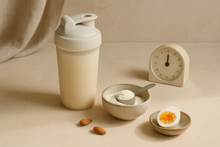
A protein shake for breakfast or as a snack helps you hit your daily protein target without wasting calories on empty carbohydrates. A shake with 25g of protein and 150 kcal does this more efficiently than a cheese sandwich (9g of protein, 280 kcal). Have a look at the starter packs for an overview of products that also suit phase 3 well.
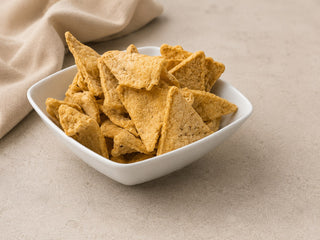
A protein bar as an afternoon snack, a protein biscuit with your coffee: these aren't products to abandon entirely after phase 2. They give you structure at moments when you might otherwise reach for something that doesn't fit the plan.
The rule of thumb for phase 3: gradually replace 1 to 2 protein products a day with a proper meal. Not all four at once. That way, calorie intake stays manageable and protein intake stays stable.
Exercise and muscle retention in phase 3
Phase 3 is the moment to reintroduce or step up your exercise routine. During a calorie-restricted diet, heavy strength training isn't advisable because the body doesn't have enough fuel for recovery. In phase 3, that changes.
With rising calorie allowance, you can progressively train more. Strength training 2 to 3 times a week supports muscle retention and boosts your basal metabolic rate. A meta-analysis published in the Journal of Obesity shows that combining high protein intake with resistance training during calorie reintroduction preserves significantly more fat-free mass than diet alone.
In practice: start with a 30-minute walk each day in week 1. Add bodyweight exercises in week 2 (squats, press-ups, planks). Introduce weights or resistance bands in weeks 3 and 4. Keep it steady. The aim is muscle stimulation, not maximum strain.
What to do if the scales start creeping up
In the first week of phase 3, weight rises for almost everyone. This is normal and has little to do with fat. Carbohydrates bind water: for every gram of glycogen, the body stores 3 grams of water. If you're eating 50g more carbohydrates a day after phase 2, that can mean 1 to 1.5 kg extra on the scales. Pure water weight.
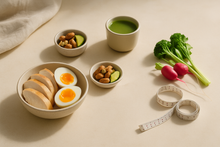
Don't be alarmed. The scales are a less reliable gauge in phase 3 than they were in phases 1 or 2. Use tape-measure checks instead: waist, hips, thighs. If these stay steady or shrink while weight ticks up slightly, things are going well. That's muscle mass and fluid balance, not fat.
Still climbing after week 2? Check whether the calorie increase was too rapid. Go back to the previous week's plan, wait 5 to 7 days, then step up again. This isn't failure. It's fine-tuning.
Sample daily menus for phase 3
Below are two concrete daily menus: one for early phase 3 (weeks 1-2) and one for later on (weeks 4-5). This gives a realistic sense of how your eating pattern evolves.
Daily menu, weeks 1 to 2 (around 1,050 kcal, 115g protein)
- Breakfast: Bioteïne protein shake (25g protein, 150 kcal) with a handful of spinach and water
- Snack: 150g Greek yoghurt 0% (15g protein, 90 kcal)
- Lunch: 150g grilled chicken breast, 200g steamed mixed vegetables (40g protein, 220 kcal)
- Snack: Bioteïne protein bar (20g protein, 200 kcal)
- Dinner: 120g salmon, 150g broccoli, 100g courgette (30g protein, 280 kcal)
Daily menu, weeks 4 to 5 (around 1,600 kcal, 95g protein)
- Breakfast: 40g porridge oats with 150g Greek yoghurt 2%, blueberries (20g protein, 320 kcal)
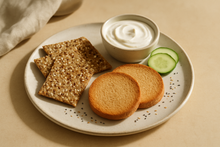
- Snack: 1 Bioteïne protein biscuit (10g protein, 120 kcal)
- Lunch: 2 slices of wholemeal bread, 100g chicken breast, lettuce, tomato (25g protein, 380 kcal)
- Snack: 30g walnuts, 1 apple (5g protein, 260 kcal)
- Dinner: 120g cod, 100g cooked brown rice, 150g stewed peppers and onion (30g protein, 420 kcal)
Notice the shift: Bioteïne protein products are down to just one occasion a day by weeks 4-5. The rest is ordinary, wholesome food. That's exactly the point. For more inspiration, browse the snacks collection and the meals collection, both suited to phase 3.
A practical checklist for a successful phase 3
Below are the points that determine whether phase 3 goes smoothly. Use this as a weekly check.
- Weigh yourself no more than twice a week, on the same day and at the same time
- Measure your waist and hips every 7 days
- Log your food for the first 3 weeks (MyFitnessPal or a notebook)
- Increase calories by no more than 100 to 150 kcal per week
- Get at least 80g of protein daily, spread across 4 to 5 meals
- Drink 1.5 to 2 litres of water a day
- Save alcohol for phase 4, not before
- Plan movement: at least 150 minutes of moderate activity per week (WHO guideline)
Not sure exactly which phase you're in or whether you're ready for phase 3? Take the phase test for personalised guidance. And you'll find the full background on high-protein eating in the high-protein diet guide.
Frequently asked questions
How long does phase 3 of a protein diet last?
Phase 3 typically lasts 4 to 6 weeks. The exact duration depends on how much weight you lost in the previous phases and how quickly your metabolism adjusts. Someone who lost 20kg will need more transition time than someone who lost 5kg.
Can I eat carbohydrates again in phase 3?
Yes, but in a structured way. Start with vegetables and pulses in weeks 1 and 2. Then add wholegrains in small portions. Sugar, white flour products and alcohol belong in phase 4, not the transition phase. Too many carbohydrates too soon triggers fat storage.
Why does my weight go up in week 1 of phase 3?
Almost always due to water retention. Carbohydrates bind glycogen, and glycogen binds water: roughly 3 grams of water per gram of glycogen. A rise of 1 to 1.5 kg in week 1 is normal and has nothing to do with fat. Check your measurements rather than just the scales.
How much protein should I eat in phase 3?
At least 80 grams a day, ideally 100 to 120 grams in the first few weeks. That's 1.2 to 1.6g per kg of body weight. This higher intake supports muscle retention while you gradually build up calories. Spread it across 4 to 5 meals for optimal absorption.
Can I skip phase 3 and go straight back to normal eating?
That's not a good idea. Without a transition phase, the body restores its fat stores faster than it rebuilds muscle mass. The result is a higher body fat percentage than before the diet, even if total weight stays the same. The British Dietetic Association always recommends a guided reintroduction after a VLCD.
How do I know I'm ready for phase 4?
You're ready for phase 4 once your weight has stayed stable at your target for 2 to 3 weeks, your measurements are steady, and your daily calorie allowance is at maintenance level. Take the phase test if you're unsure about moving to phase 4.
Do I need to stop protein products altogether in phase 3?
No. Use 1 to 2 protein products a day as a supplement, not as a replacement for every meal. A protein shake or bar helps you hit your daily protein target without wasting calories. Stopping completely makes it harder to get enough protein from regular food.
What if the transition doesn't feel right or I get strong cravings?
Strong cravings in phase 3 usually point to a calorie build-up that's too fast, or too little protein. First, increase protein intake to 120g a day, spread across 5 meals. If that doesn't help, go back to the previous week's plan and build up more slowly. See a dietitian if symptoms persist.