



Why you lose muscle mass when dieting
In a calorie deficit, the body draws energy from both fat stores and muscle tissue. Without adequate protein intake and strength stimulus, as much as 30% of total weight lost can come from muscle. That might sound like a technical detail, but it has a direct bearing on how you look and how efficiently your metabolism runs once the diet is over.
The mechanism behind muscle loss during weight loss is called catabolism. When you eat less than you burn, your body looks for alternative fuel sources. Fat is the preferred source, but muscle tissue is available too. If your protein intake is low, or if your muscles aren't given a reason to stick around through strength training, the body will happily burn muscle protein as an efficient fuel.
This isn't a theoretical risk. A meta-analysis by Eric Helms et al. (2014) in the Journal of the International Society of Sports Nutrition found that athletes who under-consumed protein during a cutting phase lost significantly more lean mass, on average, than those following an optimised protein protocol.
How much muscle loss is normal? (and why you want to minimise it)
Without a strategy, a standard calorie deficit typically results in 25 to 30% of total weight lost coming from muscle mass. With an optimised protocol, meaning sufficient protein, resistance training and a moderate deficit, that figure can drop below 10%.
That difference sounds abstract until you put numbers on it. Say you lose 10 kilograms. Without a strategy, 2.5 to 3 kilograms of that will be muscle. With a solid protocol, you'll lose less than a kilogram of muscle. The end result is visible: better definition, a firmer physique and a higher resting metabolic rate.
Muscle mass largely dictates your basal metabolic rate. Every kilogram of muscle burns roughly 13 kilocalories extra per day at rest. Lose 3 kilograms of muscle, and your annual resting energy expenditure drops by nearly 14,000 kilocalories. That's a structural disadvantage when it comes to maintaining your weight after the diet.
This is precisely why preserving muscle mass while losing weight isn't purely an aesthetic goal, it's a metabolic investment. Read more about the fundamentals in our high-protein diet guide.
The 6 strategies, ranked by impact
1. Keep protein intake high: 1.6 to 2.2 grams per kilogram of body weight
This is the single most impactful strategy. The British Dietetic Association (BDA) and numerous studies support a protein intake of at least 1.6 grams per kilogram of body weight for anyone losing weight with muscle preservation in mind. Athletes and people over 40 tend to benefit from the upper end of the range, 2.0 to 2.2 grams per kilogram.
At 80 kilograms, that translates to 128 to 176 grams of protein a day. Spread across four meals, that's 32 to 44 grams per sitting. It's achievable, but it takes planning. Add a protein shake to your daily routine and you'll cover 25 to 30 grams per serving with virtually no effort.
2. Strength train at least 3 times a week with progressive overload
Strength training gives your muscles a reason to stick around. Without mechanical load, the body has no incentive to spare muscle protein. The key is progressive overload: increasing weight, reps or volume week on week. Even a small 1 to 2% increase per week is enough to signal that your muscles are still needed.
Three sessions a week is the minimum threshold for preserving muscle during a calorie deficit. More sessions aren't necessarily better, particularly while you're running an energy shortfall.
3. Cap your calorie deficit at 20% below maintenance
An aggressive deficit (more than 25%) accelerates muscle loss considerably. The MATADOR study (Intermittent Energy Restriction, 2017) showed that a moderate, cyclical deficit leads to better preservation of lean mass compared with a continuous, larger deficit. Keep the shortfall to 400 to 600 kilocalories a day for most people. That delivers 0.5 to 1 kilogram of fat loss per week, a pace at which muscle mass is well protected.
4. Get at least 7 hours' sleep a night
Sleep deprivation raises cortisol production and lowers growth hormone and testosterone. A study published in Annals of Internal Medicine (Nedeltcheva et al., 2010) found that participants sleeping 5.5 hours lost 55% more muscle mass during a calorie deficit than those sleeping 8.5 hours. Total weight loss was identical, but body composition differed drastically. Sleep isn't an optional recovery extra, it's a structural part of muscle preservation.
5. Schedule refeeds and diet breaks every 4 to 8 weeks
A refeed is a day, or several days, where you temporarily eat at maintenance calories. A diet break is a 1 to 2 week stretch at maintenance level. Both lower cortisol, restore leptin levels and give your muscles a chance to recover. For anyone dieting continuously for more than 8 weeks, a diet break isn't a luxury, it's an effective tool for limiting muscle loss.
6. Take 3 to 5 grams of creatine a day
Creatine is one of the most thoroughly researched sports supplements around. It supports ATP resynthesis during strength training, allowing you to train more volume at the same weight. That higher training volume helps preserve muscle mass while dieting. The effective daily dose is 3 to 5 grams of creatine monohydrate. A loading phase is optional.
Table: protein requirements by body weight for muscle preservation while dieting
| Body weight | Protein per day (1.8 g/kg) | Per meal (4x) | Shake equivalent |
|---|---|---|---|
| 60 kg | 108 g | 27 g | 1 shake a day (25-30 g) |
| 70 kg | 126 g | 32 g | 1 shake a day (25-30 g) |
| 80 kg | 144 g | 36 g | 1-2 shakes a day |
| 90 kg | 162 g | 41 g | 2 shakes a day |
| 100 kg | 180 g | 45 g | 2 shakes a day |
Use the phase test to work out which protein level suits your situation and goals.
Strength training in a calorie deficit: what should you adjust?
Training in a calorie deficit calls for a different approach than training in a surplus, simply because your recovery capacity is lower. The adjustments are small but crucial.
- Reduce volume, keep intensity. Halve your training volume if you're cutting your energy intake significantly, but keep the weights and intensity the same. This tells your body your muscles are still functionally needed.
- RPE 7 to 9. Train at an effort level of 7 to 9 out of 10. You don't need to take every set to failure, but you should be working close to your limit.
- Cap sessions at 60 minutes. Training longer while in a deficit raises cortisol without adding extra muscle stimulus. Shorter and sharper is better.
- Prioritise compound movements. Squats, deadlifts, bench presses and rows recruit the most muscle mass per exercise, making them more efficient when your energy is limited.
Common mistakes when trying to lose weight without losing muscle
- Too much cardio, too little strength work. Cardio burns calories but provides no muscle stimulus. Anyone doing cardio five times a week while barely lifting weights will lose a disproportionate amount of muscle mass.
- Protein intake too low. Many popular diet plans sit at 60 to 80 grams of protein a day, which isn't enough to preserve muscle for the average person weighing 70 kilograms or more.
- Too large a deficit in the first week. A crash diet of 1,000 kilocalories a day or less accelerates muscle loss significantly, even with high protein intake. Keep the deficit manageable.
- Not tracking progress. If you're not measuring your lifts, your measurements or your strength, you have no way of knowing whether it's working. Without data, you're flying blind.
How do you measure muscle preservation at home?
A DEXA scan or BodPod gives the most accurate reading of body composition. But at home, there are four reliable methods that, taken together, give you a solid picture.
- Mirror photos. Every two weeks, same lighting, same angle, same time of day. Visual changes in definition and volume become apparent over longer stretches of time.
- Measurements. Measure your hip, chest, upper arm and thigh circumference weekly. A shrinking waist alongside stable or growing thigh measurements points to fat loss with muscle preserved.
- Strength as a proxy. If you can lift the same weights at a lower body weight, you're holding onto your muscle. A drop in strength is an early warning sign that you're pushing too hard.
- Body composition scales (bioelectrical impedance). Not the most accurate method, but useful as a trend indicator under consistent measuring conditions (same time each week, fasted).
Sample meal plan for muscle preservation while dieting
The plan below is based on an 80-kilogram person with a muscle-preservation training goal, 1,800 kilocalories a day and 145 grams of protein.
| Meal time | Food | Protein | kcal |
|---|---|---|---|
| 07:00 - Breakfast | 200 g Greek yoghurt (0%), 30 g oats, 1 egg | 28 g | 310 kcal |
| 10:00 - Pre-training | Bioteïne protein shake (1 serving) | 27 g | 160 kcal |
| 12:30 - Lunch (post-training) | 150 g chicken breast, 150 g cooked quinoa, vegetables | 42 g | 480 kcal |
| 16:00 - Snack | Bioteïne protein bar | 20 g | 190 kcal |
| 19:00 - Dinner | 150 g salmon, 200 g broccoli, 100 g sweet potato | 38 g | 480 kcal |
| 21:00 - Optional | 200 g low-fat quark | 16 g | 110 kcal |
| Total | 171 g | 1730 kcal |
Training timing: strength session at 10:30, straight after the morning shake. The post-workout meal follows within 60 to 90 minutes, which optimises protein synthesis during the recovery window.
Bioteïne products for optimal muscle preservation
The practical sticking point when preserving muscle during a diet is hitting consistently high protein targets on a tight calorie budget. That calls for protein sources with a high protein-to-calorie ratio.
The Bioteïne protein shakes deliver 25 to 30 grams of protein per serving at 140 to 170 kilocalories, making them one of the most efficient protein sources per kilocalorie available. They're designed for people who need to consistently hit high protein targets without adding extra calories.
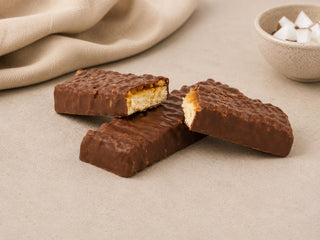
The Bioteïne protein bars contain 20 grams of protein per bar with less than 5 grams of sugar. They work well as a meal companion, a pre-workout snack or a top-up for a lunch that's light on protein. They're not a replacement for full meals, but a practical tool for hitting your daily target.
If you're after a complete starting point, take a look at the starter pack, put together for anyone just beginning a protein-focused approach to weight loss. For more context on the approach, see our explanation of the 4-phase system that Bioteïne follows.
External reference: the Dutch Nutrition Centre (Voedingscentrum) outlines the fundamentals of responsible weight loss, including the importance of protein intake during a calorie deficit.
Frequently asked questions
How much protein do I need to preserve muscle mass while losing weight?
The research-backed guideline is 1.6 to 2.2 grams of protein per kilogram of body weight per day. For someone weighing 75 kilograms, that's 120 to 165 grams of protein daily. The more active you are and the larger your calorie deficit, the higher up that range your target should sit.
Can I lose weight without losing muscle mass?
Avoiding muscle loss entirely isn't realistic in practice, but you can minimise it substantially. With sufficient protein intake, strength training and a moderate calorie deficit, muscle loss can be kept under 10% of total weight lost. That's a realistic, clinically achievable target.
How quickly do you lose muscle mass if you stop training during a diet?
Measurable losses in strength and muscle volume begin to appear after 2 to 3 weeks of inactivity. This process moves faster in a calorie deficit than at maintenance. Even two short strength sessions a week are enough to largely preserve muscle mass.
Is cardio bad for muscle mass when losing weight?
Cardio isn't bad for you, but it doesn't help preserve muscle either. Too much cardio without strength training increases the risk of muscle loss. Two to three cardio sessions a week alongside strength training strikes a balance that supports fat loss without significantly affecting muscle mass.
What's a safe rate of weight loss for preserving muscle mass?
A rate of 0.5 to 1 kilogram of weight loss per week is most favourable for muscle preservation. Faster loss, more than 1 kilogram a week, increases the likelihood that a larger share of that loss comes from muscle rather than fat.
Does creatine help with weight loss and muscle preservation?
Creatine supports muscle preservation during a diet by enabling higher training intensity even with less energy available. The supplement doesn't directly aid fat loss, but the increased training volume it allows is a proven mechanism for preserving lean mass.
What are the best protein sources for preserving muscle while losing weight?
Chicken breast, quark, Greek yoghurt, eggs, salmon and protein shakes all score well on protein-to-calorie ratio. They deliver plenty of protein per kilocalorie, which is essential when you're trying to hit your protein target on a limited calorie budget without piling on extra calories.
How do I know whether I'm losing muscle or fat during my diet?
Track your strength in the gym weekly, take measurements across several body parts, and photograph yourself every two weeks. If your strength stays stable or improves while your weight drops, you're losing predominantly fat. A drop in strength alongside weight loss signals that muscle is being lost too.