
How much protein is in porridge oats: the short answer
Porridge oats contain roughly 13 grams of protein per 100 grams of dry oats. That sounds reasonable, but an average portion weighs only 40 to 50 grams, which works out to just 5 to 6.5 grams of protein. For a breakfast that's meant to support muscle maintenance or weight loss, that's consistently too little.
The nutritional profile of oats isn't bad in itself. Wholegrain oats beat white bread hands down and bring fibre, magnesium and beta-glucans to the table. But if you're following a protein-focused diet and relying on plain oats as your protein source, you're missing the mark. A breakfast needs at least 25 to 30 grams of protein to deliver real satiety and switch on muscle protein synthesis. Plain porridge gets you to roughly a fifth of that.
What does work is using oats as a base and building in dedicated protein sources. Below you'll find exactly what that adds up to, and which combinations make the most sense.
Protein in oats per portion: a comparison table
The more useful question isn't how much protein sits in 100 grams of oats, but how much protein your finished breakfast actually contains. The table below uses a fixed base of 50 grams of dry oats (prepared with water), boosted with common protein add-ins.
| Combination | Ingredients | Protein (g) | kcal (approx.) |
|---|---|---|---|
| Plain porridge | 50 g oats + water | 6.5 | 185 |
| Porridge + low-fat quark | 50 g oats + 150 g low-fat quark | 21 | 305 |
| Porridge + Greek yoghurt | 50 g oats + 150 g Greek yoghurt (10% fat) | 18 | 370 |
| Porridge + protein shake | 50 g oats + 1 serving protein shake (25 g protein) | 31.5 | 370 |
| Porridge + stirred-in protein powder | 50 g oats + 30 g whey or casein powder | 30 | 360 |
| Porridge + 2 eggs + quark | 50 g oats + 2 eggs + 100 g quark | 29 | 420 |
The table makes one thing clear: plain oats simply don't deliver enough on their own. Only with a deliberate addition do you get close to a functional protein breakfast. For more on the 25 to 30 gram protein threshold per meal, see our high-protein diet guide.
Why plain oats fall short as a weight-loss breakfast
Weight loss hinges on protein intake per meal, not just per day. Research published in the American Journal of Clinical Nutrition shows that a threshold of roughly 25 grams of protein per meal is needed to trigger maximal muscle protein synthesis. Below that threshold, the stimulus drops off significantly.
At 6.5 grams, plain oats fall well short of that mark. This has two consequences. First, a carbohydrate-heavy breakfast without enough protein is less satiating, so you'll be hungry again sooner. Second, in a calorie deficit, insufficient protein per meal means you lose muscle mass faster. Muscle burns more calories than fat tissue, which is exactly the trap you want to avoid.
The Dutch Nutrition Centre (Voedingscentrum) recommends 0.8 grams of protein per kilogram of body weight per day as a minimum. During active weight loss or when maintaining muscle, the practical recommendation rises to 1.2 to 1.6 grams per kilogram. For someone weighing 75 kg, that's 90 to 120 grams of protein a day, spread across three to four meals. Your breakfast needs to contribute 25 to 35 grams of that. Oats alone simply can't deliver it.
Six ways to make porridge more protein-rich
The base stays the same: 50 grams of dry oats. What you add determines whether it becomes a functional breakfast or a carb bomb with a healthy reputation.
1. Low-fat quark or Skyr
Low-fat quark contains 9 to 11 grams of protein per 100 grams and is the most cost-effective ingredient you can use. Skyr sits just above that, at around 11 grams per 100 grams. Stir 150 to 200 grams into your porridge once it's cooked. Total protein: 20 to 25 grams.
2. Eggs (whole or whites only)
Two eggs deliver 12 grams of protein. Whisk them and stir into the porridge while it's still cooking. It sounds unusual, but the texture ends up similar to creamy scrambled oats. You'll barely notice the eggs if you add cinnamon or vanilla extract.
3. Stir in protein powder
Whey isolate or casein dissolves well in warm porridge. Add it once cooking is finished and the mixture has cooled slightly, otherwise it clumps. One 30-gram scoop of powder typically adds 22 to 25 grams of extra protein. Combined with the oats, that's 29 to 31 grams in total. Choose a powder without added sugars if you're watching calories.
4. Cottage cheese
Cottage cheese is currently one of the most underrated dairy products around. A low-fat version contains 11 to 12 grams of protein per 100 grams. Blend it for a smooth texture, or use it cold as a topping. 150 grams adds 17 grams of extra protein.
5. Edamame beans or tofu (for plant-based options)
Edamame contains 11 grams of protein per 100 grams and works surprisingly well in savoury porridge bowls. Soft silken tofu (150 g) delivers 8 grams of protein and has a neutral flavour. For a fully plant-based profile, combine oats, edamame and a spoonful of almond butter. Total protein: roughly 22 grams.
6. Use a protein shake as your liquid
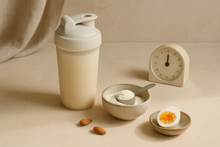
Cook the oats in a diluted protein shake instead of water. One serving of shake typically contains 20 to 30 grams of protein. The oats absorb the liquid, giving you a compact, protein-rich meal without needing to add anything else. This is the quickest method by far. Explore more shake options in the Bioteïne shake collection.
The carbohydrate nuance in oats
Dry oats contain around 58 grams of carbohydrates per 100 grams, part of which consists of beta-glucans. Beta-glucans are soluble fibres that blunt the rise in blood sugar after a meal. The European Food Safety Authority (EFSA) has approved this claim for a daily intake of at least 3 grams of beta-glucan. A 50-gram portion of oats provides around 2 grams of beta-glucan, just below that threshold.
This doesn't mean oats are automatically wrong for weight loss. The glycaemic index of oats (GI around 55) is lower than cornflakes (GI around 81) or white bread (GI around 70), making it a slower-releasing carb source. That said, the carbohydrate density is still high. If you're following a low-carb protocol or actively aiming to stay in ketosis, oats aren't the best fit.
For most people working on weight loss with a moderately low-carb approach, oats are perfectly acceptable, provided protein intake per meal is sorted. Want to know which protocol suits you best? Take the phase test.
Protein-rich porridge recipes
Three concrete recipes below. No vague descriptions, just ingredients, prep time and macros.
Recipe 1: Quark porridge with cinnamon (5 minutes)
- 50 g dry oats
- 150 ml water
- 150 g low-fat quark
- 1 teaspoon cinnamon
- A handful of blueberries (fresh or frozen)
Cook the oats with the water until thick. Let cool for two minutes. Stir through the quark. Add cinnamon. Top with blueberries.
Macros: 355 kcal, 22 g protein, 47 g carbs, 5 g fat.
Recipe 2: Savoury egg porridge (8 minutes)
- 50 g dry oats
- 200 ml water
- 2 eggs
- A pinch of salt, black pepper, chilli flakes
- 1 tablespoon grated Parmesan (optional)
Bring the water to the boil, add the oats and stir. Meanwhile, whisk the eggs. Once the porridge is nearly done, add the eggs and keep stirring over low heat until set. Season to taste.
Macros: 395 kcal, 24 g protein, 43 g carbs, 12 g fat.
Recipe 3: Overnight oats with protein shake (no cooking, prep the night before)
- 50 g dry oats
- 250 ml prepared protein shake (choose a neutral or vanilla flavour)
- 1 tablespoon chia seeds
- 100 g Greek yoghurt
Mix everything in a jar. Refrigerate overnight. Eat straight away the next morning, with fresh fruit if you like.
Macros: approx. 480 kcal, 34 g protein, 52 g carbs, 10 g fat.
When a ready-made protein breakfast is the better choice
The recipes above work, but they require prep, weighing out and having the right ingredients in stock. In practice, that falls apart on busy mornings or when you're travelling. That's when a well-formulated protein breakfast isn't the fallback option. It's the better one.
Ready-made protein meals are engineered with a precise macro profile. They consistently deliver 25 to 35 grams of protein per portion, a controlled amount of carbohydrates, and a predictable calorie count. That has a practical upside: no scales, no calculations, no risk of a stingy portion of quark.
The Bioteïne meal collection includes breakfast options specifically formulated for a protein-focused diet. Each product lists the exact protein content, carbohydrate intake and total calories. For anyone who wants consistency without cooking every morning, this is the most practical route.
Want to get enough protein on the go or between meals too? Check out the shake range or the protein snacks. The starter pack gives you a full overview of what suits your phase. Read more about how the phases work on the 4-phase system page.
The Voedingscentrum page on oats offers a solid overview of the nutritional basics. For guidance on protein intake during weight loss, the BDA protein factsheet is a reliable reference. A review published in Advances in Nutrition (2016) discusses the relationship between protein intake per meal and muscle protein synthesis in detail.
Frequently asked questions
How much protein is in porridge oats per portion?
A standard 50-gram portion of dry oats contains around 6.5 grams of protein. Per 100 grams of dry oats, that's 13 grams. That's not enough for a complete protein breakfast. Always add an extra protein source to reach the 25 grams needed per meal.
Are oats a good source of protein?
Oats are a decent plant-based protein source compared with other grains, but they're by no means a complete protein source on their own. Per portion, they simply don't deliver enough protein for muscle maintenance or targeted fat loss. They work best as a carbohydrate base, boosted with dairy, eggs or protein powder.
How many calories does porridge have with added protein?
Plain porridge (50 g) comes to around 185 kcal. Add 150 grams of low-fat quark and you're at around 305 kcal. Using a protein shake as the liquid brings you to 350 to 400 kcal, depending on the shake. That's a realistic calorie level for a satiating protein breakfast.
Can I eat porridge if I'm trying to lose weight?
Yes, provided the rest of the meal's profile is right. Oats have a lower glycaemic index than many other breakfast cereals and contain beta-glucans. But plain oats on their own don't have enough protein to be properly satiating. Always pair them with a protein-rich addition if you're on a weight-loss diet.
What's the best protein-rich addition to oats?
Low-fat quark or Skyr is the most efficient option: high protein, low fat, low calorie density. Stirring in protein powder delivers the highest protein content per portion. Eggs are a good middle ground. Greek yoghurt works too, but brings more calories due to its fat content.
How many carbohydrates are in oats?
Dry oats contain around 58 grams of carbohydrates per 100 grams, so around 29 grams per 50-gram portion. Part of that consists of beta-glucans, soluble fibres that slow the rise in blood sugar. Oats are less suited to a low-carb diet.
Are overnight oats more protein-rich than warm porridge?
Not inherently. The protein content of oats doesn't change based on how they're prepared. Overnight oats become more protein-rich if you make them with protein shake, Greek yoghurt or quark instead of regular milk or water. The method differs, but the protein still needs to be added separately either way.
What's a good alternative to oats for a protein breakfast?
If you want a breakfast that already contains enough protein without any adjustments, ready-made protein meals are the most consistent option. A good protein shake as a breakfast replacement typically delivers 25 to 30 grams of protein in five minutes, with no cooking or weighing required.