
Are protein crisps actually good for you?
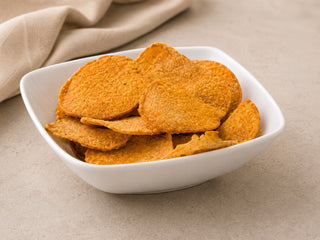
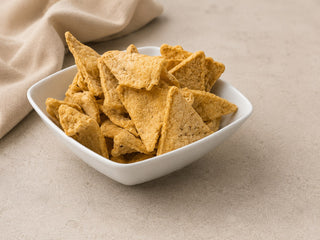
Protein crisps typically contain 30 to 40% fewer calories than standard crisps, less than half the carbohydrates, and two to four times more protein per portion. A 25g bag usually delivers 10 to 13g of protein for 110 to 130 kcal. That doesn't make them a superfood, but it does make them a sensible swap if you're going to snack regardless.
Protein crisps vs standard crisps: the numbers
Marketing claims are one thing. What actually matters is what's printed on the nutrition label. Below is a direct comparison based on a 25g portion, roughly the size of a small bowl of crisps.
| Product (per 25g) | Energy (kcal) | Protein (g) | Carbohydrates (g) | Fat (g) | Salt (g) |
|---|---|---|---|---|---|
| Standard potato crisps | 135 | 1.8 | 13.5 | 8.5 | 0.3 |
| Standard tortilla chips | 128 | 2.0 | 16.5 | 6.0 | 0.5 |
| Protein crisps (average) | 115 | 11.5 | 5.5 | 4.5 | 0.6 |
| Bioteïne protein crisps | 110 | 13 | 4.8 | 4.0 | 0.55 |
The protein difference is striking. Standard crisps barely offer 2g of protein per portion. Protein crisps deliver six times that amount. That's not a subtle nuance, it's a fundamentally different macro split within the same snacking moment.
Fat content is lower too, since protein crisps are generally baked or popped rather than fried. Carbohydrates are roughly halved, which matters if you're following a carb-restricted plan or trying to keep your insulin response in check.
Why protein crisps keep you fuller for longer
Protein is the most satiating macronutrient of the three. That's not a brand claim, it's documented across numerous nutrition science reviews. Research published in The American Journal of Clinical Nutrition shows that higher protein intake raises levels of the satiety hormone GLP-1 while suppressing ghrelin, the hunger hormone. You simply feel less inclined to keep eating.
In practical terms: imagine eating a 25g bag of standard crisps at 4pm. Twenty minutes later, you're hungry again. That same moment with protein crisps gives you 13g of protein, roughly the equivalent of a boiled egg. That keeps you satisfied for longer, especially if dinner is still a while off.
The fibre in some protein crisp varieties (made from chickpeas or lentils) reinforces this effect further. Fibre slows gastric emptying. Combined with protein, you get a snack that's genuinely satiating, not just lower in calories on paper.
For anyone who's completed a protein diet phase test and finds themselves in a calorie-restricted phase: the urge to snack doesn't vanish through willpower alone. Meeting it with a higher-protein option works far better than ignoring it.
The pitfalls of protein crisps
There are three concrete issues worth knowing before you position protein crisps as a default healthy snack in your diet.
Salt content
Protein crisps typically contain 0.5 to 0.8g of salt per 25g portion. That's comparable to, and sometimes higher than, standard crisps. The World Health Organisation recommends a maximum of 5g of salt per day. Eat two bags of protein crisps and you've already used up 20 to 30% of that daily allowance on snacks alone. If you have high blood pressure or fluid retention, that's worth factoring in.
The whole-bag trap
This is the biggest risk. Protein crisps are low in calories per portion. They're also crunchy, salty and moreish, which makes them easy to overeat. A 25g bag is fine. A 100g bag is 440 kcal and over 50g of protein, which for most people means half a day's protein target eaten in one snacking session. Calorie-wise that's not a disaster, but it does throw off your daily structure.
Weigh your portion for the first fortnight. After that, you'll know what 25g looks like without thinking about it.
Not all protein crisps are created equal
The protein crisp market is unregulated when it comes to naming. A product can be labelled "protein crisps" with just 5g of protein per 100g, barely more than standard crisps. Always check the nutrition label. A genuine protein crisp delivers at least 30g of protein per 100g. Anything below 25g is largely marketing dressing.
Check the ingredients list too. If maize starch or potato starch tops the list, the protein base is weak. Good protein crisps are built on a genuine protein foundation: whey isolate, casein, pea protein or chicken fibre protein.
When do protein crisps fit into a diet?
They're not equally relevant to every diet. Here's an honest look at where they work best.
Calorie-restricted diet (500-750 kcal deficit)
Protein crisps are a solid choice here. They fill snacking moments without derailing your calorie balance. 110 kcal for 13g of protein slots easily into a 1,400 to 1,600 kcal day. Compare that to a standard snack of 200-250 kcal for just 2g of protein: you save 100 to 140 kcal per snack, and that adds up over a week.
Protein diet (1.6-2.2g of protein per kg of bodyweight)
If you're aiming for 120 to 160g of protein daily, snack contributions matter. A 25g portion of protein crisps already provides 10% of the minimum daily requirement for someone weighing 75kg. That's efficient. Read more on building up to that daily target in our high-protein diet guide.
Ketogenic or low-carb diet
At 4.8g of carbohydrates per portion, protein crisps work well within a carb-restricted plan. They're not a keto snack by definition (some varieties contain more carbs), but within most strict low-carb guidelines of 50g per day, one portion fits without any trouble.
Simply maintaining your weight
They're suitable here too, though less essential. The occasional standard crisp is no problem within a balanced diet. But if you notice your snacking moments are frequent and you're watching your energy intake, the higher protein density of protein crisps gives you more for fewer calories.
Following a structured weight-loss plan and not sure which phase you're in? The Bioteïne phase test takes two minutes and tells you exactly which stage you're at and which snacking strategy suits it.
Athletes and active people
After training, muscle tissue needs amino acids to recover. A 13g protein snack straight after a light workout is a low-effort recovery moment, though it's no substitute for a full recovery meal or an protein shake. Treat it as a top-up, not a foundation.
Bioteïne protein crisps: what sets them apart
Most protein crisps on the market are built on a maize base with a protein coating. That's cheap to produce, but results in a weak protein foundation. Bioteïne's approach uses a protein matrix as the structural base, not as an afterthought coating.
Per 25g portion, Bioteïne crisps deliver 13g of protein and 110 kcal. The crunch is on par with standard crisps. The flavour is neutrally salted, not artificially over-the-top. No aspartame. No colourings that turn the label into a string of E-numbers.
Carbohydrates sit at 4.8g per portion, fat at 4.0g. That's the macro profile suited to a phase 2 or phase 3 approach within the Bioteïne 4-phase system.
Want to see which snacks suit your phase? Browse the full snacks range or dive straight into the starter pack if you're just getting going.
The British Dietetic Association notes in its guidance on protein that timing and spreading protein intake throughout the day matter at least as much as the total daily amount. Protein crisps offer a practical way to contribute to that spread between meals, without needing to prepare anything.
The Netherlands' Nutrition Centre (Voedingscentrum) states in its protein guidelines that most people get enough protein overall, but that the distribution across the day is often skewed: too much in the evening, too little during the day. That's precisely where a protein-rich snack between meals earns its keep.
Frequently asked questions
Are protein crisps genuinely healthier than standard crisps?
Per portion, they contain fewer calories, fewer carbohydrates and significantly more protein. That makes them functionally better suited to a calorie-restricted or protein-focused diet. They're not a health food as such, but they're a better choice for snacking compared with standard potato crisps.
How much protein is in protein crisps?
This varies considerably by brand. Good protein crisps deliver 30 to 52g of protein per 100g. Per 25g portion, that's 7.5 to 13g. Always check the nutrition label: products under 25g of protein per 100g offer little advantage over standard crisps.
Do protein crisps help with weight loss?
Indirectly, yes. Higher protein intake lowers hunger hormones and raises satiety hormones, meaning you're less likely to keep eating. They're also lower in calories than standard crisps. But weight loss requires a consistent calorie deficit sustained over multiple days. Protein crisps are a helpful tool, not a solution on their own.
Can I eat protein crisps if I'm restricting carbohydrates?
Yes. A 25g portion contains, on average, 4 to 6g of carbohydrates. That fits comfortably within a low-carb plan of 50 to 100g per day. Just keep an eye on the rest of your diet that day, since bread, fruit and dairy also contribute to your carbohydrate total.
Are protein crisps suitable for daily use?
One portion a day is fine for most people. Multiple portions can push your salt intake towards or beyond the recommended 5g daily limit. If you have high blood pressure or kidney issues, it's worth speaking to a dietitian or doctor before making high protein intake a regular habit.
When is the best time to eat protein crisps?
They're most effective when hunger strikes between meals, such as mid-afternoon or late evening. At these moments, a 13g protein snack offers real satiety. After light training, they're also useful as a recovery top-up, though not a substitute for a full protein-rich meal.
What's the calorie difference between protein crisps and standard crisps?
Per 25g portion, standard potato crisps sit at around 135 kcal. Protein crisps come in at 110 to 120 kcal, a difference of 15 to 25 kcal per portion. Over a year of daily use, that's a difference of 5,000 to 9,000 kcal, roughly equivalent to 0.7 to 1.3kg of body fat.
Are all protein crisps the same?
No. Quality varies significantly. Cheaper varieties use maize starch as a base and add only minimal protein as a coating, sometimes delivering less than 10g of protein per 100g. A genuine protein crisp is built on a real protein foundation such as whey, casein or pea protein, with at least 30g of protein per 100g.