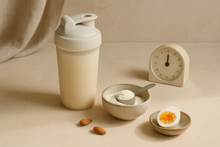


Short answer: what does protein before bed actually do?
Slow proteins such as casein and cottage cheese are digested gradually, sometimes over 5 to 7 hours. That means your muscles get a steady drip-feed of amino acids throughout the night. Research shows this supports muscle protein synthesis, and hunger levels the following morning can be noticeably lower.
Whether it also helps with weight loss depends entirely on your total calorie intake. A 25-gram protein portion late in the evening makes sense. An extra 400-kcal meal doesn't. The difference lies in how you execute it, not in the principle itself.
What is casein, and why is it "slow"?
Casein is the dominant protein in milk, making up around 80% of the total protein content in cow's milk. Whey is the other portion: quickly absorbed and ideal around training sessions. Casein works the opposite way.
In an acidic environment, such as your stomach, casein forms a gel. That gel slows gastric emptying, so amino acids trickle into your bloodstream gradually, over 5 to 7 hours rather than the 60 to 90 minutes typical of whey. For nighttime use, that's exactly what you want.
Cottage cheese is naturally rich in casein. Low-fat cottage cheese contains an average of 10 grams of protein per 100 grams, the vast majority of which is casein. That makes it one of the cheapest and most convenient evening sources going, no supplements required. Greek yoghurt sits in a similar category, though its protein content is slightly lower.
Casein shakes or puddings are more concentrated: typically 20 to 25 grams of protein per serving, with fewer calories than a bowl of cottage cheese. Useful if your calorie budget is tight.
What does the research say?
The most widely cited study on this topic is Res et al. (2012), published in Medicine & Science in Sports & Exercise. Participants who consumed 40 grams of casein protein right before bed showed 22% higher muscle protein synthesis the following morning compared with the placebo group. That's not a marginal difference.
A later meta-analysis from 2021 in Nutrients backs this up: pre-sleep protein intake, particularly casein, improves nitrogen balance and supports muscle recovery. The effect is stronger in people who train, but it's also measurable in inactive adults.
As for satiety, protein is the most filling macronutrient of the three. A portion of 25 to 30 grams raises levels of satiety hormones such as GLP-1 and PYY, while the hunger hormone ghrelin drops. This effect lasts several hours, including during sleep. Statistically, people eat less at breakfast the morning after having an evening protein-rich snack.
The Snijders et al. (2015) study in the Journal of Nutrition found that in young men, 28 grams of casein before bed, combined with resistance training over 12 weeks, led to significant increases in muscle mass and strength compared with a placebo. The casein group ended up with, on average, 1.5 kg more lean mass by the end of the trial.
Casein doesn't directly improve sleep quality, incidentally. That's a stubborn myth. The relaxation some people feel after a warm bowl of cottage cheese likely comes from tryptophan (an amino acid found in casein) and from the ritual itself, not from any pharmacological effect of the protein.
Slow protein sources for the evening: a comparison
| Source | Serving size | Protein (g) | kcal | Protein type | Practicality |
|---|---|---|---|---|---|
| Low-fat cottage cheese | 200 g | 20 | 88 | Casein (dominant) | Ready to eat, no prep |
| Greek yoghurt (0% fat) | 200 g | 18 | 100 | Casein + whey | Ready to eat |
| Curd cheese | 150 g | 18 | 111 | Casein (dominant) | Higher fat intake |
| Casein shake (powder) | 30 g powder + water | 24 | 110 | Micellar casein | Quick to make, precisely dosed |
| Casein pudding | 1 serving (approx. 200 ml) | 20-25 | 100-130 | Casein | No mixing, ready to eat |
| Edam cheese (30+) | 40 g | 10 | 124 | Casein | High fat, less ideal in large portions |
Cottage cheese scores best on protein per calorie. Casein powders and puddings are handy if you want to keep portions and macros tightly controlled, or if cottage cheese simply isn't to your taste.
Portion and timing: how do you get it right?
Studies reporting positive effects mostly use 25 to 40 grams of casein protein, taken 30 to 60 minutes before bed. That's the workable range.
For someone weighing 70 kg with a protein target of 1.6 grams per kilogram of bodyweight (112 grams total per day), a 25-gram evening portion of casein can cover 22% of the daily requirement. That's a substantial chunk.
Timing matters less than portion size. If you go to sleep at 10pm and had your evening meal at 6pm, you've got a 4-hour window without any protein intake before bed. A small casein portion at 9pm closes that gap nicely. But if you finished a large meal at 11.30pm, an extra portion is probably pointless and simply adds calories.
Have a look at the high-protein diet guide for a full overview of daily protein targets by bodyweight and activity level.
Does protein before bed actually help with weight loss?
The answer: indirectly, and only if you use it wisely.
Casein before bed supports weight loss through two mechanisms. First, it curbs appetite the following morning, which can lower your total daily calorie intake without any conscious effort on your part. Second, it protects muscle mass during a calorie deficit. This matters because, without enough protein, a calorie deficit costs you not just fat but muscle too. Less muscle means a lower resting metabolic rate and fewer calories burned at rest.
A 2020 meta-analysis in Obesity Reviews concluded that higher protein intake during dieting (1.2 to 1.6 g per kg) preserves up to 50% more lean mass compared with a low-protein approach. Casein at night is one way to hit that total protein target without loading up your daytime meals.
Not sure where you stand on protein intake or which diet phase suits you? The phase test helps you work it out in under 2 minutes.
There's no magic involved. It's about a consistently higher protein percentage across the whole day, with the evening portion acting as a strategic top-up to your other meals. Not a replacement. And certainly not a bonus meal stacked on top of an already full day's eating.
The pitfalls: when doesn't it work?
Late-evening snacks nearly always fail for the same reason: the calories get added, not shifted. You eat a normal day's worth of food, then tack on cottage cheese, cheese or a shake as an "extra". The result is a calorie surplus, even though the source itself is protein-rich.
A few concrete scenarios where this goes wrong:
- You've already eaten 2,200 kcal and add 200 g of cottage cheese on top. That's 88 kcal extra with no corresponding deficit. Over a year: roughly 32,000 extra kcal, or about 4 kg of fat gain.
- You use a casein shake that also contains carbs and fats (some products come in at 300 kcal per serving). Read the label. Always.
- You mix the cottage cheese with honey, granola or fruit, which doubles the calories without adding to the casein benefit.
- You finish your evening meal as late as 10.30pm and then have another portion after that. That extra serving is then pointless in terms of timing and unnecessary in terms of calories.
The Dutch Nutrition Centre recommends 0.83 grams of protein per kilogram of bodyweight as a minimum threshold for adults. Scientific consensus for people who are active or losing weight sits higher: 1.2 to 2.0 grams per kg. Evening protein is only useful if it fits within that overall target, not as an add-on to an intake that's already sufficient.
Bioteïne and casein options for the evening
If cottage cheese isn't your thing, or you want precise control over portion size and macros, Bioteïne shakes are a practical alternative. They use micellar casein as the primary protein source: 25 grams of protein per serving, around 120 kcal, with no unnecessary additions.
These shakes are designed for use within a structured eating plan. They're not a meal replacement for your evening meal, but a targeted 25-gram protein top-up for the moment your body can put it to good use overnight. Browse the full range via the shake collection.
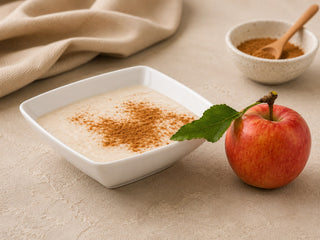
Prefer eating to drinking before bed? A casein pudding is worth a look. The texture is thick, the protein density is high, and sugar content stays low. A sensible choice if you're mid-way through a calorie-restricted diet and still want something that feels like a proper meal.
Want to know how casein fits into a broader approach? The high-protein diet guide explains how to spread your protein intake across the day, evenings and recovery included.
Frequently asked questions
Is eating cottage cheese before bed good for weight loss?
Cottage cheese before bed can support weight loss if it fits within your daily calorie target. Its high casein content curbs appetite the following morning and protects muscle mass during a calorie deficit. 200 grams of low-fat cottage cheese delivers 20 grams of protein for just 88 kcal.
How much casein do you need before bed?
Research typically uses portions of 25 to 40 grams of casein protein, taken 30 to 60 minutes before sleep. For most adults, 25 to 30 grams is a practical and effective starting point, equivalent to roughly 250 grams of low-fat cottage cheese or one casein shake.
Does it matter whether you take casein or whey before bed?
Yes. Whey is absorbed quickly, peaking in the blood within 60 to 90 minutes. Casein releases amino acids over 5 to 7 hours. For nighttime use, casein's slow release is more effective for muscle recovery and satiety.
Can I use ordinary yoghurt instead of cottage cheese?
Ordinary yoghurt contains less protein than cottage cheese and proportionally more whey relative to casein. Greek yoghurt (0%) is a better option: 18 grams of protein per 200 grams. Its casein content is lower than cottage cheese, but still the dominant protein fraction.
Does eating before bed make you gain weight?
The timing of eating itself has no proven fat-gaining effect. What counts is your total daily calorie intake. A cottage cheese or casein portion of 100 to 130 kcal before bed won't cause weight gain, provided it fits within your calorie budget.
How long before bed should I take casein?
30 to 60 minutes before bed is sufficient. Casein doesn't need a specific absorption window before intake. Digestion begins as soon as you eat and continues through the night. Taking it earlier (say, 2 hours before bed) is also fine, just not necessary.
Is casein suitable for everyone?
Casein is a milk protein and isn't suitable for people with a cow's milk allergy. For those with lactose intolerance, it depends on sensitivity: casein contains very little lactose, but trace amounts may be present. If in doubt, consult a dietitian or GP.
How does casein before bed fit into a diet programme?
Casein before bed works best as part of a structured protein plan. It's a top-up to your daytime protein intake, not a replacement for it. Use the phase test to find out which approach suits your situation.