






The short answer: does protein timing really matter?
Protein timing does have an effect, but it's more modest than decades of gym folklore would have you believe. The famous 'anabolic window' actually spans 4 to 6 hours after a session, not 30 minutes. For most people who train, total daily protein intake remains by far the biggest factor in muscle recovery and growth.
What the research actually says about the 'anabolic window'
The idea of a narrow anabolic window comes from early research into post-exercise muscle protein synthesis. The logic seemed straightforward: muscles are maximally receptive to amino acids straight after training, so you'd better get a shake down quickly. Wait longer than 30 to 45 minutes, the thinking went, and you'd missed your chance.
A widely cited meta-analysis by Schoenfeld, Aragon and Krieger (2013), published in the Journal of the International Society of Sports Nutrition, largely dismantles that assumption. The researchers reviewed 23 controlled studies and found that the timing of protein intake around exercise had a statistically weak effect once total daily protein intake was matched across groups. The window of heightened muscle sensitivity turns out to run for 4 to 6 hours, not half an hour.
What explains this wider window? Resistance training raises mTOR signalling activity and the availability of amino acid transporters in muscle tissue for several hours after exercise. A meal eaten 90 minutes before training can, in theory, still be supplying sufficient circulating amino acids by the time you finish your last set. The line between 'before' and 'after' is far blurrier, physiologically speaking, than the supplement industry has suggested for decades.
Read the full meta-analysis via BioMed Central: Schoenfeld et al. 2013.
Protein before training: worthwhile or not?
Pre-training protein has genuine value in specific circumstances. It's not a universal necessity, but for certain sessions it can make a measurable difference.
When pre-training protein is worthwhile
- Longer sessions (over 60 minutes): during intensive strength sessions of 60 to 90 minutes, circulating amino acid levels drop noticeably if you train fasted. A portion of 20 to 25 g protein, taken 60 to 90 minutes before training, helps keep those levels stable.
- Fasted, or more than 4 hours since your last meal: if you train early in the morning and last ate at 8pm the evening before, you've been fasting for 10 to 12 hours. Pre-training protein here isn't a luxury, it's recovery support.
- Heavy compound lifts: squats, deadlifts and pulls place a substantial metabolic load on muscle tissue. Having amino acids available from the outset limits muscle breakdown (catabolic balance) during the session itself.
When pre-training protein matters less
- You trained 1 to 2 hours after a proper protein-rich meal. The amino acids are already available.
- Sessions under 45 minutes at moderate intensity.
- Your daily total is already on target (see further down this article).
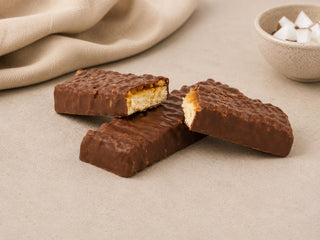
A practical pre-training portion is 20 to 25 g. That's enough to prime muscle protein synthesis without overloading digestion. A Bioteïne protein bar delivers 20 g of protein per serving in a compact, easily digestible format, which is handy if you're heading straight from the office to the gym.
During training: when does protein make sense?
For most people, taking protein during training is unnecessary and can even be counterproductive. Intra-workout protein slows gastric emptying and can cause digestive discomfort during intense sessions.
There are two situations where intra-workout protein has a genuine evidence base:
- Endurance sessions over 90 minutes: during prolonged endurance exercise (marathon, triathlon, cycling), the body starts drawing on muscle tissue for fuel once glycogen stores run low. A small amount of protein (10 to 15 g) combined with carbohydrates can limit this muscle breakdown. This is primarily relevant for competitive endurance athletes, though.
- Training twice a day: if recovery between two sessions is under 8 hours, a small protein portion during or immediately after the first session can speed up recovery ahead of the second. See the practical examples further down.
For a standard strength session lasting 45 to 75 minutes, water and possibly electrolytes are the most sensible intra-workout support. Focusing on protein during training adds little and distracts from what actually matters: your total daily intake.
Protein after training: what's optimal?
Post-workout protein is the best-supported timing moment, though the critical window is wider than long assumed. The British Dietetic Association recommends 20 to 40 g of protein within 2 hours of a training session for optimal muscle protein synthesis.
Dosage
Studies show a plateau effect at 20 to 40 g of protein per serving for muscle protein synthesis. Eating more per dose doesn't produce an extra anabolic signal for the muscles; the surplus is used for other physiological processes or simply oxidised. Larger athletes (over 90 kg) or those doing extremely intense sessions sit closer to the 40 g mark. For most people, 25 to 35 g per post-workout serving is sufficient.
Type of protein: whey, casein or plant-based?
Whey protein is often seen as the post-workout gold standard thanks to its rapid digestibility and high leucine content. Leucine is the primary trigger for mTOR and, in turn, muscle protein synthesis. Casein digests more slowly and is less suited as an acute post-workout protein, but excels as a pre-bed option (see practical examples).
Plant-based protein (soy, pea, rice) scores slightly lower on leucine content per gram, but at an adequate serving (30 to 40 g), the outcomes are comparable to whey, as shown in a 2019 study by van Vliet et al. The difference between protein types is relevant but not decisive. Hit the right dose, and the physiological outcomes are largely similar.
The Bioteïne protein shakes come in both whey-based and plant-based varieties, delivering 25 to 30 g of protein per serving to suit the post-workout needs of different athletes.
Table: recommended protein timing by sport type
| Sport type | Before training | During training | After training | Additional daily target |
|---|---|---|---|---|
| Strength training | 20-25 g if fasted or over 4 hours since eating | Not necessary | 25-40 g within 2 hours | 1.6-2.2 g per kg bodyweight |
| HIIT / CrossFit | 15-20 g, easily digestible, 60 min before | Not necessary | 25-35 g within 90 min | 1.6-2.0 g per kg bodyweight |
| Cardio (moderate, 30-60 min) | Not necessary | Not necessary | 15-25 g within 2 hours | 1.2-1.6 g per kg bodyweight |
| Endurance (over 90 min) | 20-25 g, 60-90 min before | 10-15 g for sessions over 90 min | 30-40 g within 60 min | 1.4-1.8 g per kg bodyweight |
Sources: British Dietetic Association Sport and Exercise Nutrition Register, Schoenfeld et al. 2013, ISSN Position Stand 2017.
The biggest mistake: too little total protein
Many people who train pour energy into fine-tuning their timing while falling short of the baseline target of 1.6 g protein per kg bodyweight per day. That's the priorities the wrong way round.
Say you weigh 80 kg and do strength training four times a week. Your daily target is then a minimum of 128 g protein. Research from the Netherlands Nutrition Centre shows that the average person consumes around 85 to 90 g of protein per day. For anyone actively building muscle, that's a good 30 to 40% below the recommended amount.
Timing optimisations deliver, at best, a 5 to 10% extra benefit when your total is already on point. But if your total falls 40% short, no timing protocol on earth will make up the difference. Sort out your daily target first, then fine-tune the timing.
The Bioteïne high-protein diet guide offers a step-by-step overview of how to calculate and hit your daily target through food and targeted supplementation. If you want to know which phase you're in, the Bioteïne phase test is a useful starting point.
Practical examples
Evening strength training: the pre-bed casein strategy
You train at 7pm. After training, you eat a meal containing 35 g protein at 8:30pm. You go to bed at 11pm. The following morning, your body is already busy with muscle repair processes from around 4am, which require amino acids. Topping up with pre-bed casein (30-40 g) just before sleep has been shown in several studies to support overnight muscle protein synthesis. Casein digests over 5 to 7 hours, keeping amino acid release in sync with the recovery peak during sleep.
Fasted morning cardio: the refeed window
You run for 45 minutes in the morning, fasted. Your hormone profile (high growth hormone, low insulin) makes fasted cardio appealing for fat oxidation. Protein beforehand isn't needed for sessions under 45 minutes. But the post-workout window is now critical, since you've been fasting for 10 to 12 hours. Eat a meal containing 25 to 35 g protein within 30 to 60 minutes of finishing to kick-start muscle protein synthesis properly and limit catabolism.
Training twice a day: protein pacing
Competitive athletes or people in an intensive training block sometimes train twice daily. With a recovery window of 6 to 8 hours between sessions, protein pacing becomes relevant: split your daily target into portions of 20 to 30 g at each eating occasion (roughly every 3 to 4 hours). This keeps amino acid levels elevated throughout the day. A total of 160 to 180 g protein per day spread across 5 to 6 occasions is a well-supported approach in this context.
How Bioteïne products fit every timing moment
Bioteïne offers products suited to every relevant timing moment, with no unnecessary additives and transparent macro information per serving.
- Pre-training: Bioteïne protein bars are compact, quickly digestible and deliver 20 g protein per bar. Suitable 60 to 90 minutes before an intense session, or as a quick top-up when your last meal was a while ago.
- Post-training: Bioteïne protein shakes deliver 25 to 30 g protein per serving and come in whey-based and plant-based varieties. They fit neatly within the 2-hour post-workout window without requiring a full meal.
- Within the 2-hour window as a full meal: Bioteïne protein meals offer 30 to 35 g protein alongside a balanced nutritional profile. Suitable as a post-workout recovery meal for those who'd rather eat than drink after training.
- Pre-bed: the higher-protein casein variants within the shake range work well as a pre-bed portion of 30 to 40 g for overnight muscle recovery.
Take a look at the complete Bioteïne starter pack if you'd like to have every timing moment sorted without planning each purchase separately. The pack is built around the Bioteïne 4-phase system for progressive protein building.
Frequently asked questions
Do I need to eat protein straight after training?
Straight away isn't necessary. The anabolic window runs 4 to 6 hours after training, not 30 minutes. Eat a portion of 20 to 40 g protein within 2 hours of your session for optimal muscle recovery. If you already had protein shortly before training, the urgency is even lower.
Is protein before or after training better for building muscle?
Both moments count. Research from Schoenfeld et al. shows that total daily protein and how it's spread across meals matter more than the specific moment. If you only choose one, post-workout has a slight edge thanks to the heightened muscle sensitivity right after exercise.
How much protein do I need after training?
20 to 40 g per post-workout serving is the evidence-backed range. Athletes up to 80 kg do well with 25 to 30 g. Larger athletes or those training extremely intensely sit closer to 35 to 40 g. More per serving offers no extra anabolic benefit for the muscles.
Does the anabolic window actually exist?
It does, but it's wider than long assumed. Not 30 minutes, but 4 to 6 hours after training, muscles remain more receptive to amino acids. This revision has been confirmed across several controlled studies, including the 2013 meta-analysis by Schoenfeld et al.
Is training on an empty stomach bad?
Fasted training increases muscle breakdown during sessions lasting over 45 minutes. For shorter cardio sessions, the effect is limited. If you train fasted for longer than 45 minutes, consider 15 to 20 g protein beforehand. Always aim for a protein-rich meal within 60 minutes of finishing.
Does the type of protein matter post-workout?
Whey has a slight edge due to its higher leucine content and faster digestibility. Plant-based protein is comparably effective at an adequate serving (30 to 40 g). The type of protein matters less than the total dose per serving and how it's spread across the day.
How should I spread my protein across the day if I train in the evening?
Split your daily target into 4 to 5 portions of 25 to 35 g. Breakfast, lunch, and a snack before training. After training, a larger post-workout meal. Consider pre-bed casein as a fifth occasion to support overnight recovery during intensive training weeks.
Is protein useful during spinning or cycling?
Only for sessions over 90 minutes. For shorter or moderately intense rides, protein during the session isn't needed. During long endurance rides, combine 10 to 15 g protein with carbohydrates for a muscle-sparing effect. Always aim for 25 to 35 g post-workout within 60 to 90 minutes of finishing.