












How much protein is in an egg?
A medium egg (around 55 grams) provides roughly 6.5 grams of protein. That protein is split between the white and the yolk: the white contributes around 3.6 grams, the yolk about 2.7 grams. Together, that makes an egg one of the most complete protein sources you can eat, with a biological value of around 100.
Protein in the white, the yolk, or both?
Many people assume the white is the only source of protein. That's not quite right. The yolk does contain less protein than the white, but it's far from an empty calorie bomb. It also supplies vitamins A, D, B12 and choline, a nutrient most people don't get enough of through their diet.
If you only eat the white to save calories, you're not just missing out on the yolk itself, but on a good chunk of these micronutrients too. Whether that trade-off makes sense depends on your calorie budget for the day. For most people, though, the advice is simple: eat the whole egg.
Nutritional values at a glance
| Component | Weight (g) | Protein (g) | kcal | Fat (g) |
|---|---|---|---|---|
| Whole egg (M, raw) | 55 | 6.5 | 78 | 5.3 |
| Egg white (only) | 33 | 3.6 | 17 | 0.1 |
| Egg yolk (only) | 17 | 2.7 | 55 | 4.5 |
| Whole egg (L, raw) | 65 | 7.7 | 92 | 6.3 |
Source: Voedingscentrum, hen's eggs.
Eggs versus other protein sources
6.5 grams of protein per egg might sound modest. But per calorie, an egg is remarkably efficient: 78 kcal for 6.5 grams of protein works out to about 12 kcal per gram of protein. Compare that with a glass of whole milk (150ml), which delivers 5 grams of protein for 95 kcal, nearly 19 kcal per gram of protein.
| Protein source | Portion | Protein (g) | kcal | kcal per g protein |
|---|---|---|---|---|
| Chicken breast (fried) | 100 g | 31 | 165 | 5.3 |
| Cottage cheese (low-fat) | 150 g | 18 | 90 | 5.0 |
| Egg (whole, M) | 55 g | 6.5 | 78 | 12.0 |
| Greek yoghurt (0%) | 150 g | 15 | 88 | 5.9 |
| Tuna (in water) | 100 g | 24 | 103 | 4.3 |
| Edamame (boiled) | 100 g | 11 | 122 | 11.1 |
So eggs aren't the most efficient protein source if you're purely counting grams. But they're cheap, quick to prepare, and pair well with almost anything. That makes them genuinely valuable in practice, including as part of a high-protein diet.
Cooking method and protein retention
Cooking denatures the protein in an egg. That sounds like a downside, but it's actually a good thing. Raw egg white contains avidin, a compound that blocks the absorption of biotin (vitamin B8). Heating deactivates avidin, which means a cooked egg actually delivers more usable protein than a raw one.
Research published in the Journal of Nutrition (Evenepoel et al., 1998) found that protein digestibility for cooked eggs sits at 91 percent, compared with just 51 percent for raw eggs. In practical terms, of the 6.5 grams of protein in a raw egg, you only absorb around 3.3 grams. Cooked, that rises to nearly 6 grams.
Cooking methods compared
| Cooking method | Estimated protein (absorbable) | Calorie impact | Practicality |
|---|---|---|---|
| Hard-boiled | ~6.0 g | None extra | Easy to take with you |
| Poached | ~5.9 g | None extra | No added fat |
| Scrambled (dry pan) | ~5.8 g | None extra | Quick, warm |
| Fried (in butter) | ~5.8 g | +90 kcal (per 10g butter) | Flavour, higher calorie intake |
| Raw | ~3.3 g | None | Not recommended |
Frying in plenty of butter or oil pushes up calorie intake considerably. Three eggs fried in 20 grams of butter can easily add up to 350 kcal. If you want to keep the calorie count low, boil or poach your eggs instead.
How many eggs a day is sensible?
This is a question where the advice has shifted considerably over the past few decades. Until the 1990s, the guidance was to eat no more than three eggs a week, due to their cholesterol content: a whole egg contains around 186mg of cholesterol, almost entirely in the yolk.
More recent research paints a much more nuanced picture. A meta-analysis in the British Medical Journal (Drouin-Chartier et al., 2020) found no significant link between moderate egg consumption (up to one egg a day) and cardiovascular disease risk in healthy adults. The British Dietetic Association states that healthy people can eat up to seven eggs a week without an increased cardiometabolic risk.
There's one caveat worth noting. If you have type 2 diabetes or an existing elevated cardiovascular risk, it's worth discussing your egg intake with a dietitian, particularly if you're eating more than one a day.
In practice, two eggs at breakfast (13 grams of protein in total) is a perfectly good choice for most healthy adults. Want to know how much protein you personally need each day? The Bioteïne phase test can help you work it out in under two minutes.
Eggs in a weight-loss diet
Eggs are a solid choice if you're trying to lose weight, for two concrete reasons.
Firstly, they're highly satiating. Of all the macronutrients, protein has the greatest satiety value. A breakfast with two eggs leaves you feeling fuller than the same number of calories from toast or cereal. An RCT published in the International Journal of Obesity (Vander Wal et al., 2008) found that participants who ate an egg breakfast for eight weeks lost 65 percent more weight than a control group eating a bread-based breakfast, with the same calorie intake.
Secondly, eggs are calorically manageable. Two poached eggs contain 156 kcal and 13 grams of protein, an efficient way to work towards your protein target without blowing your calorie budget.
If you're after a structured, long-term approach to losing weight with a high-protein diet, the Bioteïne high-protein diet guide is a good place to start. It explains exactly how much protein you need at each phase.
A high-protein breakfast with eggs: what actually works?
Two eggs as your sole source of breakfast protein comes to 13 grams. For an adult aiming for 1.6 to 2.0 grams of protein per kilogram of body weight, that's rarely enough to cover the whole breakfast. At 75kg, you'd need 120 to 150 grams of protein a day, which works out to 30 to 38 grams per meal across four meals.
Two eggs, then, only give you roughly half of what you need at breakfast. It's worth pairing them with additional protein sources:
- 100g low-fat cottage cheese (11g protein) + two eggs = 24g
- Two eggs + 100g smoked salmon = 26g
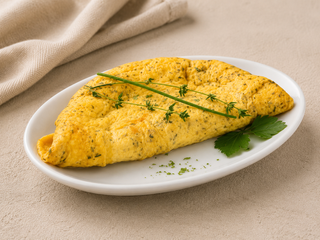
- Two-egg omelette + 30g grated Parmesan = 28g
- Two eggs + 150g Greek yoghurt (0%) = 28g
Combinations like these get you close to the 30 grams you're after per breakfast. A meal built entirely around eggs is fine on a busy morning, just keep an eye on your total protein for the day.
When is a protein shake more convenient than an egg?
Eggs are versatile, but not always practical. Here are three situations where a shake is the better option:
- No time to cook. Frying or boiling eggs takes five to ten minutes. A shake is ready in thirty seconds. On a morning with an early meeting, that can be the difference between hitting your protein target or not.
- After training. In the first 30 to 60 minutes after a workout, rapid protein absorption is beneficial. A whey protein shake is absorbed faster than solid food. Eggs are solid nutrition, but not the optimal choice at that specific moment.
- Calorie-conscious targets. A 150 kcal shake with 30 grams of protein is hard to match with eggs without significantly raising your calorie intake. Five eggs give you 32 grams of protein, but also 390 kcal.
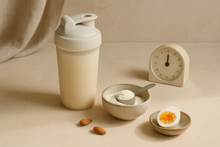
The Bioteïne protein shakes are specifically designed for people who want to optimise their protein intake without the hassle. They pair well with an egg-based breakfast: two eggs plus a shake quickly gets you to 35 to 40 grams of protein before you've even left the house.
Looking for more than just a shake, a full high-protein breakfast or snack? Take a look at our high-protein meals or protein bars for on the go.
Frequently asked questions
How much protein is in one egg?
A medium egg of around 55 grams contains roughly 6.5 grams of protein. A large egg (65 grams) provides slightly more, around 7.7 grams. The protein is split between the white (3.6g) and the yolk (2.7g), so ideally eat the whole egg.
Is it better to eat only the egg white for more protein and less fat?
Eating only the egg white does save on fat and calories, but you also miss out on valuable micronutrients from the yolk, such as choline, vitamin D and B12. For most people, the whole egg is the better choice, unless you're following a strict calorie deficit.
How many eggs a day is safe?
Based on current research, healthy adults eating one to two eggs a day don't face an increased risk of cardiovascular disease. The British Dietetic Association sets seven eggs a week as a safe upper limit. If you have diabetes or an elevated cardiovascular risk profile, it's worth checking with a dietitian.
Does a raw egg provide less protein than a cooked egg?
Yes. The digestibility of protein from a raw egg is around 51 percent, compared with 91 percent for a cooked egg (Evenepoel et al., 1998). Of the 6.5 grams of protein in a raw egg, you effectively absorb only around 3.3 grams. Eating raw eggs isn't advisable for several reasons.
Are eggs a good protein source for weight loss?
Yes. Two poached eggs provide 13 grams of protein for just 156 kcal. They're satiating and help preserve muscle mass during a calorie deficit. Research shows that an egg breakfast leads to significantly greater weight loss than a carbohydrate-heavy breakfast with the same calorie intake.
How many eggs do you need to reach 30 grams of protein?
Relying on eggs alone means eating almost five eggs to hit 30 grams of protein, which comes to around 390 kcal. It's better to pair two eggs with cottage cheese, Greek yoghurt or a protein shake. That way, you reach 30 grams of protein within a more realistic calorie budget of 300 to 350 kcal.
What is the biological value of an egg?
The biological value of an egg is around 100. This is the reference value against which other proteins are measured. It means the amino acid profile of egg closely matches what the human body needs, so the protein is used efficiently for muscle maintenance and growth.
When is a protein shake better than eggs as a protein source?
A shake is more convenient after training (faster absorption), on busy mornings when there's no time to cook, and when you need a lot of protein without a high calorie intake. A serving of Bioteïne protein shakes provides 25 to 30 grams of protein in around 150 kcal, something five eggs can't match without driving calories up significantly.