






The short answer: how much protein do you need to lose weight?
For weight loss, the optimal protein intake sits between 1.6 and 2.2 grams of protein per kilogram of body weight per day. At 75 kg, that works out at 120 to 165 grams of protein daily. Clinical research shows that this range protects muscle mass during a calorie deficit, curbs appetite and supports fat metabolism.
Curious which amount suits your situation? Read on for the step-by-step calculation and a detailed table by weight.
Why do you need more protein when losing weight?
Lose weight without enough protein and you won't just shed fat, you'll lose muscle too. That's medically undesirable and, in practical terms, counterproductive. Below are the three evidence-based reasons why protein intake sits at the heart of any effective diet.
1. Preserving muscle mass during a calorie deficit
In a negative energy balance, the body breaks down energy stores for fuel. Without adequate protein intake, muscle protein becomes an easy target. This phenomenon, known as muscle catabolism, lowers your basal metabolic rate, meaning you burn fewer calories in the long run and regain weight more quickly.
The British Dietetic Association (BDA) states that an intake of at least 1.6 g/kg/day is sufficient to maintain muscle mass on a calorie-restricted diet in adults. For adults over 60, the upper threshold of 2.0 g/kg/day is recommended, owing to age-related muscle loss (sarcopenia).
2. The satiety effect: less hunger, less snacking
Protein has the highest satiety value of the three macronutrients. It stimulates the production of satiety hormones such as GLP-1 and PYY, while suppressing the hunger hormone ghrelin. Clinical research shows that participants on a high-protein intake (over 25% of total energy) spontaneously consumed up to 441 kcal less per day, without any conscious restriction.
In practice, this means fewer cravings for snacks, fewer binges and steadier energy levels throughout the day.
3. The thermic effect: protein burns more energy
Digesting and processing protein costs the body more energy than processing carbohydrates or fats. This is known as the thermic effect of food (TEF). For protein, the TEF is 20 to 30%, meaning that of every 100 kcal of protein, the body retains a net 70 to 80 kcal. By comparison, the figure is 5 to 10% for carbohydrates and just 0 to 3% for fats.
Over a day, this adds up to an extra 80 to 100 kcal burned on a high-protein diet. That may sound modest, but over weeks and months it makes a significant difference to the overall energy balance.
Calculate your protein needs: step by step
The calculation itself is straightforward, but it does require one decision: do you use your actual body weight or your target weight? At a healthy weight or with mild excess weight (BMI up to 30), use your actual weight. Where BMI exceeds 30, it's more accurate to use your target weight, since fat mass doesn't significantly raise protein requirements.
Formula
Protein requirement (grams) = body weight (kg) × factor (1.6-2.2 g/kg)
- Maintenance / lightly active: 1.6 g/kg
- Active weight loss with exercise: 1.8 g/kg
- Intensive training + weight loss: 2.0-2.2 g/kg
Example calculation 1: 60 kg, lightly active, goal = weight loss
Weight: 60 kg. Factor: 1.8 g/kg (active weight loss).
60 × 1.8 = 108 grams of protein per day
In practice: spread across 3 to 4 meals, that's roughly 27 to 36 grams of protein per sitting.
Example calculation 2: 75 kg, moderately active, goal = weight loss with strength training
Weight: 75 kg. Factor: 2.0 g/kg (training plus weight loss).
75 × 2.0 = 150 grams of protein per day
In practice: 3 meals of 40 grams of protein each, topped up with a snack or a 30-gram shake.
Example calculation 3: 90 kg (target weight 75 kg), limited activity
Target weight: 75 kg. Factor: 1.6 g/kg (conservative, little movement).
75 × 1.6 = 120 grams of protein per day
In practice: 4 meals averaging 30 grams of protein each. This ties in closely with the 30g-per-meal principle explained further below.
Want to know which approach suits your specific situation? Take the Bioteïne phase test and receive personal advice based on your weight, activity level and goal.
Table: protein per day by weight and goal
The table below gives a practical overview of daily protein needs based on body weight and goal. Use the column that best matches your situation.
| Body weight | Maintenance (1.4 g/kg) |
Weight loss, lightly active (1.6 g/kg) |
Weight loss, moderately active (1.8 g/kg) |
Weight loss + strength training (2.0-2.2 g/kg) |
|---|---|---|---|---|
| 50 kg | 70 g | 80 g | 90 g | 100-110 g |
| 55 kg | 77 g | 88 g | 99 g | 110-121 g |
| 60 kg | 84 g | 96 g | 108 g | 120-132 g |
| 65 kg | 91 g | 104 g | 117 g | 130-143 g |
| 70 kg | 98 g | 112 g | 126 g | 140-154 g |
| 75 kg | 105 g | 120 g | 135 g | 150-165 g |
| 80 kg | 112 g | 128 g | 144 g | 160-176 g |
| 85 kg | 119 g | 136 g | 153 g | 170-187 g |
| 90 kg | 126 g | 144 g | 162 g | 180-198 g |
| 100 kg | 140 g | 160 g | 180 g | 200-220 g |
Where BMI exceeds 30, use your target weight for the calculation. Consult a dietitian for personal advice if you have a medical condition, kidney issues or are pregnant.
How should you spread protein across the day?
The total grams of protein per day form the foundation. But timing and distribution across the day largely determine how effectively that protein is used, for muscle retention, satiety and recovery.
The 30-gram principle per meal
Clinical research shows that muscle protein synthesis is maximally stimulated by an intake of 25 to 40 grams of protein per meal. Eating more protein at a single meal doesn't proportionally boost muscle retention, the surplus is largely oxidised or converted.
In practice, this means spreading your daily total across 3 to 4 meals, each containing at least 25 grams of protein. With a daily target of 120 grams: four meals of 30 grams each works better than one 80-gram shake plus two small meals.
Breakfast: the most underrated protein meal
Research consistently shows that most people follow an ascending protein pattern through the day: little at breakfast, a moderate amount at lunch, and plenty at dinner. This is suboptimal for muscle retention. A protein-rich start to the day, at least 25 to 30 grams, helps regulate appetite more effectively and stimulates muscle protein synthesis more evenly over 24 hours.
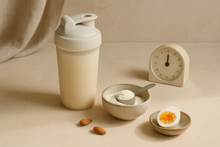
In practice: a bowl of quark with nuts provides around 15 grams. A Bioteïne protein shake delivers a standard 25 grams with minimal calories, a reliable way to bring your breakfast up to standard, day after day.
Protein before bed: overnight recovery
Consuming 30 to 40 grams of protein before bed, preferably slow-digesting casein protein, has been shown in clinical settings to improve overnight recovery and boost muscle protein synthesis in both athletes and non-athletes. This is particularly relevant on a calorie-restricted diet, where the risk of muscle catabolism overnight is higher.
Common mistakes when counting protein
Many people overestimate their protein intake, thanks to a handful of stubborn misconceptions. Below are the most common mistakes, and how to avoid them.
Mistake 1: confusing product weight with protein content
A 150-gram chicken breast doesn't contain 150 grams of protein. Chicken breast contains roughly 23 grams of protein per 100 grams, so 150 grams of cooked chicken provides around 30 grams of protein. Anyone who doesn't check this on the label or in a nutrition app will systematically overestimate their intake.
Mistake 2: overestimating plant-based sources
Plant-based proteins, such as those in beans, lentils and grains, have a lower biological value and a less complete amino acid profile than animal proteins. That doesn't make them worthless, but digestion and utilisation are less efficient. Anyone eating fully plant-based would do well to increase their recommended intake by 10 to 20% to compensate.
Mistake 3: using the wrong baseline figure
The official Health Council guideline, 0.8 grams of protein per kilogram, is designed to prevent deficiencies in healthy adults in energy balance. For weight loss and muscle retention, this figure is demonstrably insufficient. Anyone relying on this guideline while dieting risks muscle loss and a slower metabolism.
Mistake 4: forgetting protein in drinks
Milk, quark-based dressings, soup and some plant-based drinks contain measurable amounts of protein. The reverse is also true: if you think you're getting enough but don't count your liquid intake, you may overlook a shortfall.
Mistake 5: focusing only on the total, not the distribution
As described above, 120 grams of protein in a single meal is physiologically less effective than 120 grams spread across four meals. The total is the foundation, the distribution determines the quality of the result.
How Bioteïne helps you hit your daily protein target
Getting 120 to 165 grams of protein a day is achievable, but it takes planning. Especially on a calorie-restricted diet, where eating less overall makes it harder to hit your protein target without overshooting your calorie budget. This is exactly what Bioteïne is built for.
The Bioteïne 4-Phase System is built around this principle: high protein, controlled calories, tailored to your goal at every phase. Each phase has its own protein target, linked to the degree of calorie restriction and the expected rate of weight loss.
Bioteïne shakes deliver an average of 25 grams of protein per serving at around 200 kcal, so a meal replacement contributes to both your protein target and your calorie budget, without any nutritional calculations required.
What sets Bioteïne apart from generic protein powders:
- A full spectrum of micronutrients per serving (vitamins, minerals, trace elements)
- A protein profile based on high-quality sources with a complete amino acid spectrum
- Adjusted per phase to match energy needs and the pace of weight loss
- A clinically grounded structure, in line with principles from Cambridge Diet research and VLCD protocols
Browse the full range of Bioteïne protein shakes, available by phase, flavour and pack size.
Not sure which phase you're in, or want to know how much protein is optimal for your weight and goal? Take the Bioteïne phase test. Based on your weight, activity level and goal, you'll get concrete daily advice, including a protein target for every meal.
Want more background on the role of protein within a structured diet first? The Bioteïne High-Protein Diet Guide offers a full overview of protein sources, absorption rates and practical meal plans by calorie level.
Conclusion: know what you need, and hit it consistently
The question "how much protein a day for weight loss" has a concrete answer: 1.6 to 2.2 grams per kilogram of body weight, depending on activity level and goal. This isn't a marketing claim, it's a clinically supported guideline that aligns with BDA recommendations and published research on weight loss in adults.
The practical challenge isn't the calculation, that part is simple. The challenge is daily consistency: enough protein at every meal, well spread across the day, within a calorie budget that supports weight loss. That's exactly what Bioteïne structures for you.
Take the phase test today and discover which daily protein target suits you, and how the Bioteïne 4-Phase System helps you hit it every single day.
Disclaimer: the protein ran