









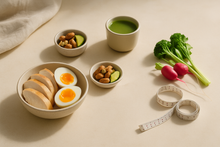


Protein versus carbohydrates: what actually works when you're trying to lose weight?
For weight loss, protein beats carbohydrates. A higher protein intake (1.6 to 2.2 g per kg of body weight per day) increases feelings of fullness, protects muscle mass and raises the thermic effect of food by 20 to 35 per cent. Carbohydrates aren't the enemy, but they simply deliver less satiety per calorie than protein does.
What protein and carbohydrates actually do in your body
Both macronutrients supply energy, but they go about it in fundamentally different ways. Carbohydrates are the fastest fuel: glucose enters the bloodstream quickly, the pancreas responds with insulin, and cells store any surplus as glycogen or, with prolonged excess, as fat. Protein behaves differently. It's broken down into amino acids, which the body uses for muscle repair, enzyme production, hormone regulation and dozens of other functions. Only once more protein arrives than is needed does it get converted into energy or stored.
The difference also shows up in thermogenesis. Digesting protein burns off 20 to 35 per cent of the calories consumed. For carbohydrates, that figure is 5 to 10 per cent, and for fat it's a mere 0 to 3 per cent. A 400 kcal meal high in protein therefore delivers considerably less net energy than an identical-calorie meal based on carbohydrates. The gap sounds small, but it adds up over the weeks.
The role of insulin
Insulin isn't the villain, but it does suppress fat burning for as long as levels stay high. Rapidly absorbed carbohydrates (white bread, sugar, fizzy drinks) trigger a sharp insulin spike. Protein-rich meals also raise insulin slightly, but the spike is flatter and shorter-lived. That means more time each day spent in a mild fat-burning state, especially if your meal timing is also on point.
The satiety effect: why protein keeps hunger at bay
Hunger is the number one reason diets fail, not a lack of willpower. A protein-rich meal stimulates the release of PYY and GLP-1 (satiety hormones) and suppresses ghrelin (the hunger hormone). A study published in The American Journal of Clinical Nutrition found that participants who raised their protein intake from 15 to 30 per cent of total calories ate 441 kcal less per day spontaneously, without deliberately counting calories.
That's no small margin. 441 kcal a day over 30 days adds up to 13,230 kcal. In theory, that's nearly 1.9 kg of fat mass (at 7,000 kcal per kg). No hunger to endure, no app to track, purely down to changing the composition of your food.
Carbohydrates can also be filling, but this depends heavily on the type. Wholegrains, pulses and vegetables contain fibre that slows gastric emptying. Sugar and refined carbohydrates barely do this at all. After a plate of pasta with tomato sauce, you're peckish again within two hours, whereas a meal with the same calories but more protein and fat can keep hunger at bay for four or five hours.
Muscle mass: the difference most diets overlook
Losing weight without paying attention to muscle mass is a mistake that damages your metabolism in the long run. Every kilogram of muscle burns 13 to 15 kcal a day at rest. That sounds modest, but someone who loses 3 kg of muscle through a poor diet ends up with a resting metabolic rate that's 45 kcal a day lower. After a year, that's over 16,000 kcal, equivalent to more than 2 kg of fat you're no longer automatically burning off.
Research from the British Dietetic Association confirms that a protein intake of at least 1.6 g per kg of body weight during a calorie deficit protects muscle mass significantly better than the standard intake of 0.8 g per kg. For someone weighing 80 kg, that's the difference between 64 g and 128 g of protein a day. In practical terms: two extra protein-rich meals or a protein shake per day.
Why carbohydrates don't protect muscle mass
Carbohydrates indirectly spare muscle by serving as fuel, meaning the body is less likely to burn amino acids for energy. But this effect is weak compared with an adequate protein intake. If you have to choose, and during a calorie deficit you always do, protein comes first. Top up with carbohydrates afterwards, not the other way round.
A calorie deficit is the foundation, but macro balance determines the quality
One thing is certain: you lose weight by eating fewer calories than you burn. That principle isn't up for debate. But what you actually lose during a calorie deficit depends directly on your macro balance. A 1,500 kcal diet low in protein leads to loss of both fat and muscle. A 1,500 kcal diet with 30 to 35 per cent protein protects muscle and increases the proportion of fat in what's lost.
| Macronutrient | Calories per gram | Thermic effect | Satiety per kcal | Muscle preservation in a deficit |
|---|---|---|---|---|
| Protein | 4 kcal | 20-35% | High | Strong |
| Carbohydrates | 4 kcal | 5-10% | Moderate (depends on type) | Indirect, limited |
| Fat | 9 kcal | 0-3% | High (due to delayed gastric emptying) | Neutral |
The practical takeaway: treat protein as the anchor of every meal. Build carbohydrates and fats around it. Our high-protein diet guide breaks this principle down day by day.
How many carbs can you still eat while losing weight?
This is where a lot of people get stuck. They cut carbohydrates out entirely and, within three days, hit a wall of low energy, irritability or awkward social situations. None of that is necessary. For most people, cutting out carbohydrates completely is neither required nor sustainable.
A workable approach: keep carbohydrates between 100 and 150 g a day, sourced from vegetables, pulses, oats and the occasional wholegrain. That's enough for stable blood sugar and training, without living in a constant carb craving. Anyone training more than four times a week can push this up towards 175 to 200 g.
Which carbohydrates cause the fewest problems
- Vegetables (unlimited, 3 to 7 g carbohydrates per 100 g)
- Pulses (lentils, chickpeas: high in fibre, slow release, also a protein source)
- Oats (around 60 g carbohydrates per 100 g, but high in fibre)
- Sweet potato (slow release, gives a filling feeling)
- Low-glycaemic fruit: berries, apple, pear
Carbohydrates worth limiting
- White bread, white rice, ordinary pasta (fast glucose release, low in fibre)
- Fizzy drinks and fruit juices (liquid carbohydrates don't trigger satiety)
- Sugary breakfast cereals
- Biscuits, sweets, cakes (high calorie density, zero satiety)
The phase test helps you work out which balance suits you best right now, based on your starting point and your goal.
A practical comparison: a low-protein day versus a high-protein day
Abstract theory only helps once you see it in practice. Below are two daily menus with the same calorie total of 1,600 kcal, but a fundamentally different macro split.
| Meal | Menu A: low protein | Menu B: high protein |
|---|---|---|
| Breakfast | Cornflakes with semi-skimmed milk (55 g carbohydrates, 8 g protein) | Greek yoghurt with berries and nuts (15 g carbohydrates, 22 g protein) |
| Lunch | Cheese sandwich + apple (52 g carbohydrates, 14 g protein) | Chicken breast salad with chickpeas (22 g carbohydrates, 38 g protein) |
| Snack | Rice cakes with jam (28 g carbohydrates, 2 g protein) | Protein bar (21 g carbohydrates, 20 g protein) |
| Dinner | Pasta with tomato sauce (78 g carbohydrates, 12 g protein) | Salmon with vegetables and quinoa (30 g carbohydrates, 42 g protein) |
| Total | 213 g carbohydrates, 36 g protein | 88 g carbohydrates, 122 g protein |
Menu A will almost certainly leave you hungry within 2 to 3 hours. Menu B keeps you going all day long. With menu A, the odds of snacking between meals are high. With menu B, that urge barely surfaces. That's not down to willpower. It's biochemistry.
High-protein eating in real life: obstacles and solutions
The theory is clear enough. But getting 120 to 160 g of protein a day from whole foods takes time. Chicken, quark, fish, eggs, pulses: it all needs planning, shopping and cooking. Easy enough on a Monday, not so easy on a Thursday evening when you're home late and the fridge is bare.
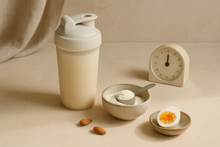
That's precisely why convenient protein solutions exist. Not as a replacement for real food, but as backup for the moments when the system's about to break down. A protein shake with 30 g of protein and 150 kcal takes 90 seconds to make. A high-protein meal ready in five minutes gives you 35 to 40 g of protein without any cooking stress. These aren't shortcuts. They're structural solutions to a structural problem.
For anyone wanting a structured start, the starter pack is designed to give you achievable protein targets for the first two weeks, without having to rethink what you're eating every single day.
Realistic protein targets by body weight
| Body weight | Minimum (0.8 g/kg) | Optimal for weight loss (1.8 g/kg) | Maximum useful (2.2 g/kg) |
|---|---|---|---|
| 60 kg | 48 g | 108 g | 132 g |
| 75 kg | 60 g | 135 g | 165 g |
| 90 kg | 72 g | 162 g | 198 g |
| 105 kg | 84 g | 189 g | 231 g |
If you're carrying significant excess weight, base your figures on your target weight or an adjusted weight (fat-free mass plus a margin), rather than your current weight. Otherwise, the targets become unrealistically high.
What does the evidence say: a brief summary of the research
The scientific consensus is clear. A 2012 meta-analysis published in the British Journal of Nutrition reviewed 24 randomised controlled trials and concluded that higher protein intake consistently led to greater weight loss, with muscle mass preserved, compared with control diets. The effect was greater in people carrying excess weight than in those at a healthy weight.
The Netherlands Nutrition Centre recommends 0.83 g of protein per kg of body weight as the daily requirement. That's a baseline for healthy adults with no specific goal. For weight loss with muscle preservation, that recommendation falls short. Researchers such as Stuart Phillips (McMaster University) and Eric Helms (Auckland University of Technology) work with targets of 1.6 to 2.4 g per kg in the context of calorie-deficit diets, regarding this as both safe and effective.
So is a very low-carb diet (ketogenic, under 50 g a day) better? It's effective in the short term, partly due to the loss of glycogen-bound water. Over the long term (beyond 12 months), results are comparable to high-protein diets with a moderate carbohydrate split. But drop-out rates are higher. The restrictions are stricter. Eating socially becomes harder. For most people, a moderate high-protein approach is more sustainable than a strict low-carb diet.
The practical conclusion: what to change tomorrow
You don't need to overhaul your diet completely. Three concrete changes make the biggest difference:
- Raise your protein intake to 1.6 g per kg of body weight. Start there. Work out your target. Track it for three weeks. Everything else tends to fall into place after that.
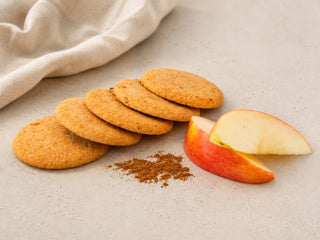
- Swap refined carbohydrates for protein-rich alternatives. Not a ban on carbs, but a conscious shift. Cornflakes to Greek yoghurt. White bread to chicken breast. Biscuits to a protein cookie.
- Plan your protein intake ahead for busy days. The evening you don't get home until 8pm is the evening you'll reach for pizza or crisps. A shake, a bar or a ready-made protein meal at those moments isn't a compromise. It's a smart choice.
Ditching carbohydrates isn't the answer. Prioritising protein is. That's the core of the 4-phase system Bioteïne works with: a structured progression where protein intake forms the foundation of every stage, with carbohydrates adjusted to suit the goal and the phase.
Frequently asked questions
Do I need to avoid carbohydrates completely to lose weight?
No. For most people, cutting them out completely is neither necessary nor sustainable long-term. An intake of 100 to 150 g of carbohydrates a day, sourced from vegetables, pulses and wholegrain sources, works well alongside a protein intake of 1.6 to 2.2 g per kilogram of body weight.
How much protein do I need if I want to lose weight?
For weight loss with muscle preservation, 1.6 to 2.2 g of protein per kg of body weight per day is recommended. If you're carrying significant excess weight, use your target weight as the basis. This is considerably more than the standard recommendation of 0.83 g per kg, which applies to people with no specific weight-loss goal.
Is a ketogenic diet better than a high-protein diet?
In the short term, a ketogenic diet often delivers quick results, partly due to water loss. After 12 months, results are comparable to a high-protein diet with moderate carbohydrates. Ketogenic diets have higher drop-out rates due to their social restrictions. For most people, a high-protein approach is more sustainable.
Why am I always hungry when I eat carbohydrates?
Rapidly absorbed carbohydrates, such as white bread, sugar and processed grains, cause a quick rise in blood sugar followed by a dip. That dip activates hunger hormones. Protein and fibre slow gastric emptying and stimulate satiety hormones such as PYY and GLP-1, keeping hunger at bay for longer.
Can I eat too much protein?
For people with healthy kidneys, an intake of up to 2.2 g per kg of body weight is safe. Higher amounts offer no extra benefit and are simply burned as energy. Anyone with kidney issues should always consult a doctor or dietitian before increasing their protein intake. For most healthy people, overconsumption is rarely a genuine risk.
What are the best protein sources for everyday use?
Chicken breast, Greek yoghurt, quark, eggs, tuna, mackerel, pulses and tofu are among the most efficient sources. Supplements such as protein shakes and protein bars are useful on busy days or as a top-up. They don't replace a varied diet, but they do offer a reliable buffer when the system's under pressure.
How quickly will I see results from eating more protein?
You'll notice the satiety effect within the first 3 to 5 days. Weight loss through muscle preservation and fat burning usually becomes visible after 2 to 4 weeks. In the first week, weight drops partly due to water loss. By weeks two and three, the scale gives a more realistic picture of fat loss.
Which carbohydrates are least harmful for weight loss?
Vegetables, pulses, oats and low-glycaemic fruit, such as berries and apples, are the best choices. They contain fibre that slows absorption and extends the feeling of fullness. Avoid refined varieties such as white bread, sugary drinks and processed breakfast cereals as much as possible.