
Travelling during a protein diet: what you need to know
Hitting your daily protein target of 100 to 160 grams while you're away from home is entirely achievable. Most people don't fail through lack of discipline, but through lack of preparation. With the right snacks in your bag, a simple ordering system for restaurants, and a clear idea of your protein sources for every situation, you can get through any trip without derailing your progress.
Travel brings its own logistical chaos: different time zones, unfamiliar kitchens, no fridge, airports with limited choice. Many people simply decide to "take a break" from their diet. That's understandable, but it's also unnecessary. A holiday of 7 to 14 days without structure can set your recovery back by weeks, particularly if you're in an active fat-loss phase. Clawing that back is harder work than the holiday itself.
This article gives you a workable system. No vague advice, just concrete gram counts, concrete situations and concrete choices.
Why travel sabotages your protein intake (and how it happens)
The problem isn't that eating healthily on the road is impossible. The problem is that standard travel options are almost always carb-heavy and protein-poor. A croissant at the airport contains 6 grams of protein and 280 kcal. A typical pasta dish from a restaurant chain gives you 18 grams of protein for 650 kcal. These aren't edge cases, they're the norm.
Research published in Appetite (2019) shows that people in environments with limited choice automatically gravitate towards familiar, energy-dense products. Airports are the textbook example. You're walking through a terminal, you've got 40 minutes, you're already worn out from an early flight. So you grab whatever's available. That's rarely a grilled chicken breast with 35 grams of protein.
Consistently low protein intake over several days has measurable consequences. Muscle breakdown can begin within 48 to 72 hours of a significant shortfall, especially combined with a lower overall calorie intake. On top of that, appetite tends to increase when protein is low, which triggers impulsive eating. That's the downward spiral many travellers recognise: a poor choice, hunger, then an even poorer choice.
Calculating your daily target for on the road
Before you pack, work out your daily target. It's trip-specific, since you might be moving more, or less, than you would at home.
The rule of thumb from the British Dietetic Association: 1.2 to 1.6 grams of protein per kilogram of body weight per day for those actively losing weight or aiming to preserve muscle mass. At 80 kilograms, that's 96 to 128 grams a day. On a holiday with plenty of walking or beach activity, you can push towards the upper end of 1.6 grams.
| Body weight | Minimum protein/day | Optimal protein/day | kcal from protein (optimal) |
|---|---|---|---|
| 60 kg | 72 g | 96 g | 384 kcal |
| 70 kg | 84 g | 112 g | 448 kcal |
| 80 kg | 96 g | 128 g | 512 kcal |
| 90 kg | 108 g | 144 g | 576 kcal |
| 100 kg | 120 g | 160 g | 640 kcal |
Not sure which phase of your diet you're currently in, or exactly how much protein is right for you? The phase test gives you a personal starting point in two minutes.
Packing: what always comes with you
This is the crux of travelling successfully on a protein diet. Not what you order in restaurants, but what you have on hand when nothing decent is available.
The basic kit for any trip over 24 hours
- Protein shakes in sachets or pre-mixed: no fridge required, stable at room temperature, 25 to 35 grams of protein per serving. A protein shake fits into any hand luggage.
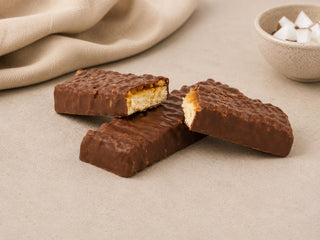
- Protein bars: compact, virtually unsquashable, 15 to 22 grams of protein per bar. Three bars in your rucksack is a whole day's backup. Have a browse of the range of protein bars if you don't have a favourite yet.
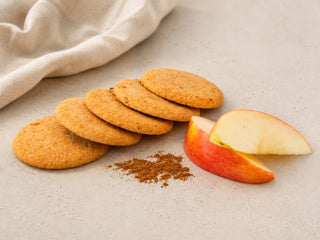
- Protein biscuits: handy for moments when a bar feels a bit too "sporty". They blend in more easily in a normal setting. Protein biscuits work well if you've got social eating moments ahead.
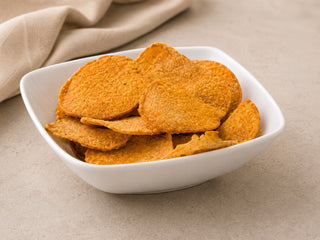
- Snacks for in between: protein-rich snacks fill the gaps without wrecking your calorie budget.
A realistic kit for 7 days: 7 shake sachets, 14 bars, 7 biscuits. That fits in a wash bag and weighs under 1 kilogram. If you use 1 shake and 2 bars daily as backup, that delivers an average of 55 to 75 extra grams of protein per day. The rest comes from your meals.
Liquid rules at the airport
A mixed shake counts as a liquid, so it falls under the 100 ml hand luggage rule. Sachets aren't a problem. A ready-to-drink shake of 330 ml needs to be left at security or drunk before you go through the check. Sachets and bars always pass through without issue.
At the airport: navigating without slipping up
Airports are designed to get your money out of your pocket, not to feed you well. Even so, there are usable options if you know what to look for.
What works, what doesn't
| Option | Protein | kcal | Verdict |
|---|---|---|---|
| Croissant | 6 g | 280 kcal | Skip it |
| Yoghurt (150 g, plain) | 8 g | 90 kcal | Acceptable as a top-up |
| Smoked salmon wrap | 22 g | 380 kcal | Good choice |
| Hard-boiled eggs (2) | 13 g | 140 kcal | Good choice |
| Ham and cheese sandwich | 18 g | 420 kcal | Fine, but check the calories |
| Protein bar (own brand) | 20 g | 220 kcal | Best option |
| Pasta bolognese | 18 g | 650 kcal | Skip it |
Airport shops such as an M&S Simply Food or WHSmith nearly always stock hard-boiled eggs, cottage cheese or Greek yoghurt. These are reliable fallback options once your own supply has run out.
On the plane: order wisely or pack wisely
Airline meals are a well-known letdown when it comes to protein content. A standard economy-class meal typically contains 15 to 22 grams of protein for 400 to 600 kcal. That's not disastrous, but it's not enough if it's your only meal on a long flight.
On flights of more than 4 hours, ordering a special meal in advance (via the airline app) is often the smarter move. A "high-protein meal" or "diabetic meal" contains, with most airlines, more protein and fewer fast-releasing carbohydrates. Not every airline offers this, but it's worth checking. You'll usually get served earlier too, as a bonus.
On a flight of 3 hours or less, just bring your own bar. That's simpler than relying on whatever's on board.
Hotels and accommodation: the kitchen check
The type of accommodation largely determines how much control you have over your protein intake.
Hotel with breakfast buffet
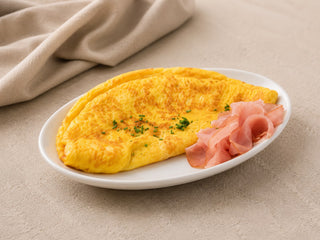
This is actually the easiest scenario. A decent European breakfast buffet almost always has eggs (boiled, scrambled or poached), cold cuts, cheese, cottage cheese or yoghurt. A breakfast of 2 eggs, 100 grams of cottage cheese and 50 grams of cured meat already gives you 38 to 42 grams of protein for around 350 kcal. That's a strong start to the day.
What you can skip: the croissants, the white bread, the jam, the fruit juices. They fill your calorie budget without contributing any protein. Have fruit if you fancy it, but don't treat it as a substitute for your protein sources.
Apartment or Airbnb
This gives you the most freedom, since you can do your own shopping. In virtually every country, the following products are easy to find and consistently protein-rich:
- Eggs (6 g protein per egg)
- Greek yoghurt (10 g per 100 ml)
- Chicken breast or turkey (30 g per 100 g)
- Tinned tuna (25 g per 100 g)
- Cottage cheese (11 g per 100 g)
- Edamame (11 g per 100 g, frozen)
With a basic set of these products, you'll hit 80 to 100 grams of protein a day without any complicated cooking or unusual kitchens. A pan, a fridge and 15 minutes is all it takes.
Camping or limited facilities
Here, your own stash becomes the most critical factor. Ready-made protein meals that don't need refrigeration are your lifeline. Combine those with locally bought tuna, eggs or yoghurt for variety.
Eating out: ordering without dropping your target
Social meals are part of travelling. You don't want to be the person turning down half the menu or ordering something entirely separate. Thankfully, you don't have to be.
By cuisine: the best choices
Almost every cuisine has a protein-rich option, if you know what to look for.
| Cuisine | Best choice | Estimated protein | Avoid |
|---|---|---|---|
| Mediterranean | Grilled fish or meat with salad | 35-45 g | Pasta, pizza |
| Asian | Steamed chicken or tofu with vegetables | 28-38 g | White rice as a main |
| American | Burger without the bun, extra patty | 40-50 g | Chips, milkshakes |
| Turkish/Greek | Kebab or souvlaki with tzatziki | 30-40 g | Pitta and rice |
| French | Salade Niçoise or steak | 30-45 g | Quiche, croque-monsieur |
| Indian | Tandoori chicken or a paneer dish | 25-35 g | Naan, rice dishes |
One practical technique: always swap the standard sides (chips, rice, bread) for extra vegetables or an additional salad. This usually costs nothing extra and keeps your calories down while the meal's protein content stays intact. Most restaurants will do this without any fuss if you simply ask.
The Dutch Nutrition Centre points out that the average person is already at the lower end of recommended protein intake. On holiday, where meals tend to be more carbohydrate-driven, that intake often drops even further. That's reason enough for active attention, not paranoia, but conscious choices.
Time zones and meal rhythm: dealing with jet lag in practice
Long flights across multiple time zones disrupt your hunger and satiety signals. That's not just in your head, your circadian clock also regulates hormones such as leptin and ghrelin. With jet lag, that rhythm is temporarily thrown off. You'll feel hungry at odd hours and won't be hungry at your usual mealtimes.
The strategy that works: keep your protein intake on track, but let go of strict timing for the first 48 hours. Eat when you're hungry, but make the right choice when you do. A bar with 20 grams of protein at 2am local time beats a bag of crisps at 8am simply because you didn't know what else to grab.
After 2 to 3 days, your rhythm adjusts on its own. Just expect the first 48 hours to involve a bit of improvisation.
The starter pack as trip preparation
If you're not yet sure which products work best for you, or you'd rather not start your trip on a trial-and-error basis, the starter pack is a sensible place to begin. That way you'll already know what you enjoy, what agrees with your stomach on the move, and how to hit your daily target before you even set off.
Discovering mid-trip that a particular shake doesn't sit well in the heat or after activity is annoying. Testing it at home takes 10 minutes and saves you a bad day on holiday.
For more background on how a protein diet works structurally, including over the long term, read the high-protein diet guide.
The day before departure: a checklist
Preparation is everything. The evening before your flight or trip is the right moment to sort this, not the morning itself.
- Work out your protein target for the length of the trip (see the table above).
- Pack at least 3 days' worth of backup (bars, sachets, biscuits) separate from what you expect to get from meals.
- Check whether your destination has a supermarket near your accommodation.
- Find out whether your hotel offers a breakfast buffet and what's on it.
- Note down 2 to 3 nearby restaurants with a protein-rich option on the menu.
- Make sure sachets and bars go in your hand luggage, not your checked bag.
- Drink enough water. Protein slightly increases your fluid needs, and flying already dehydrates you.
That sounds like a lot, but steps 1 to 7 together take 20 minutes. That's the investment that makes the difference between a holiday that interrupts your progress and a trip you simply carry on through.
Want to know how this fits into a longer weight-loss strategy? The 4-phase system explains how travel periods fit within the different phases of a protein diet, including maintenance phases where the rules are a little more relaxed.
Frequently asked questions
How much protein do I need per day if I'm on holiday and not doing much exercise?
With minimal activity, stick to 1.2 grams of protein per kilogram of body weight per day as a lower bound. At 75 kilograms, that's 90 grams. Active holidays with plenty of walking or swimming justify 1.4 to 1.6 grams. Use the phase test for a more personal figure.
Am I allowed to bring my protein shake on the plane?
Sachets and protein powders in bags aren't liquids, so they always go through security without issue. A pre-mixed, ready-to-drink shake falls under the 100 ml liquid rule and can't come in hand luggage if it's over 100 ml. Mix it only after you've passed through security.
What do I do if there's nothing healthy available at the airport?
Then you use what you've brought with you. That's exactly why you pack bars and sachets in your hand luggage. If you haven't got any, look for a supermarket or kiosk selling hard-boiled eggs, Greek yoghurt or a piece of cheese. That's almost always available somewhere.
Can I be less strict with my protein target during an active holiday?
More activity actually increases your protein needs, it doesn't reduce them. Muscles recover from exertion via protein. An active holiday is therefore an argument for paying more attention to protein intake, not less, particularly if you're in an active weight-loss phase.
What are the best protein-rich options at an average European restaurant?
Grilled meat or fish without sauce is available almost everywhere and delivers 30 to 45 grams of protein per portion. Ask for extra vegetables instead of chips or rice. A salad starter with egg or fish boosts your protein intake without significantly raising your total calories.
How do I handle eating occasions I can't control, such as a business trip with client lunches?
Start the day with a protein-rich shake or a solid breakfast of at least 30 grams of protein. That way you'll be less hungry when you reach a lunch you can't steer yourself. Then choose the most protein-rich item available and use your own snacks to top up later in the day.
Do protein bars or shakes cause stomach issues on the road because of the heat?
In high temperatures, products containing dairy protein can sit less well. Store sachets somewhere cool and never mix more than you'll drink straight away. Plant-based protein powders made from pea or rice tend to be better tolerated by most people in heat and fatigue.
How long can I miss my protein target before it affects my results?
With a significant shortfall (more than 40 percent below target), measurable muscle loss can begin after 48 to 72 hours. A single day of moderate intake does little harm. Three to four consecutive days of shortfall, combined with an overall calorie deficit, has a visible impact over time. That's reason enough not to let it slide for several days in a row.